Most organizations think about backups when they think about disasters.
A ransomware attack. A server failure. A cloud outage. A natural disaster. An accidental deletion.
These are the events that typically drive backup conversations.
But there is another threat that often receives less attention.
Silent data loss.
Unlike ransomware, silent data loss does not announce itself. There is no ransom note. No flashing alert. No immediate system outage. Operations continue. Employees keep working. Applications remain online.
Everything appears normal.
Until someone discovers that critical data has been corrupted, altered, overwritten, or missing for weeks, months, or even years.
By that point, the organization's backup retention policy may no longer provide a path to recovery.
This is where immutable backups become increasingly important.
As organizations become more dependent on cloud platforms, SaaS applications, digital workflows, automation, and interconnected systems, the risk of silent data loss continues to grow. Traditional backup strategies remain necessary, but many organizations are discovering that retention policies alone are not enough.
The question is no longer whether data is backed up.
The question is whether the organization can recover data that was quietly compromised long before anyone realized there was a problem.
The Backup Conversation Has Changed
For years, backup discussions focused primarily on hardware failures and disaster recovery.
The objective was straightforward.
If a system failed, restore it.
If a file was deleted, recover it.
If a server crashed, rebuild it.
That model still matters.
But today's environments are significantly more complex.
Organizations rely on cloud storage, collaboration platforms, ERP systems, CRM applications, financial systems, databases, virtual environments, and third-party software services. Data moves continuously between users, devices, applications, vendors, and automated processes.
As complexity increases, so do opportunities for unnoticed corruption.
A synchronization error can overwrite thousands of files.
A software bug can gradually corrupt records.
An insider can alter information without immediate detection.
A compromised account can modify data while avoiding security alerts.
A faulty integration can propagate errors across multiple systems.
In each case, the organization may continue operating without realizing that data integrity has already been compromised.
That matters.
Because backups can only protect data that still exists in a recoverable state.
Understanding Silent Data Loss
Silent data loss occurs when information becomes corrupted, altered, deleted, or rendered unusable without immediate detection.
The damage may occur gradually.
The discovery may happen much later.
This delay creates risk.
Imagine a financial reporting system that contains corrupted records for six months before an audit uncovers the issue.
Consider a healthcare organization that discovers patient documentation was improperly synchronized across systems several months earlier.
Think about a legal firm that learns archived case files were silently overwritten by a misconfigured application.
In each scenario, backups may exist.
The challenge is determining whether those backups contain clean data.
If corrupted information has already been copied into subsequent backups for months, the organization may discover that every available restore point contains the same problem.
The backup worked exactly as designed.
The recovery strategy did not.
Why Retention Policies Have Limits
Retention policies remain an essential part of data protection.
Organizations need them for compliance, governance, operational recovery, and legal requirements.
But retention alone does not guarantee recoverability.
Many organizations assume that keeping backups for 30, 60, 90, or even 365 days automatically protects them against all forms of data loss.
The reality is more complicated.
A retention policy determines how long backup data is stored.
It does not necessarily protect that data from modification, deletion, corruption, or compromise.
An attacker with sufficient privileges may target backup repositories.
A malicious insider may attempt to remove recovery points.
Administrative errors can alter backup configurations.
Compromised credentials can create unexpected exposure.
The longer an issue remains undetected, the greater the possibility that affected data has already propagated across multiple backup cycles.
This creates a dangerous assumption.
Many organizations believe retention equals protection.
They are not the same thing.
The Growing Importance of Data Integrity
When most leaders think about cybersecurity, they think about confidentiality.
Who can access the data?
Others focus on availability.
Can we access the data when we need it?
But integrity deserves equal attention.
Can we trust the data?
That question is becoming increasingly important.
If financial records are altered, business decisions may suffer.
If operational data becomes corrupted, automation may fail.
If customer information becomes inaccurate, trust may be damaged.
If healthcare records are compromised, patient outcomes may be affected.
Data that cannot be trusted creates operational risk.
And operational risk eventually becomes business risk.
This is why modern backup strategies must focus not only on preserving data but also on preserving confidence in the accuracy and authenticity of that data.
Immutable Backups Create a Different Layer of Protection
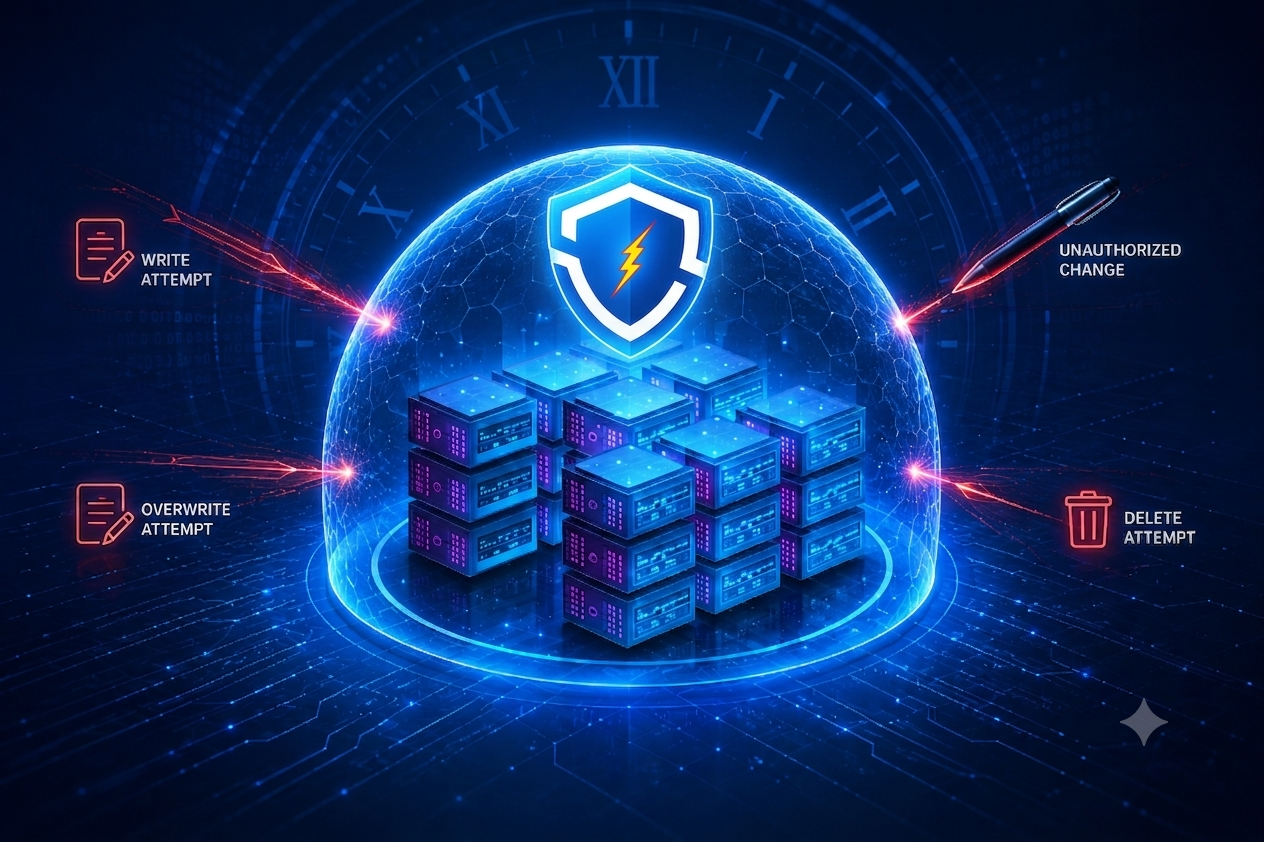
Immutable backups are designed so that backup data cannot be modified, altered, deleted, or overwritten during a defined protection period.
Once the backup is written, it becomes locked.
Even administrators may be unable to change it until the immutability period expires.
This changes the recovery equation.
Instead of relying solely on retention schedules, organizations gain assurance that protected backup copies remain unchanged after creation.
That distinction is significant.
An immutable backup is not simply stored.
It is preserved.
This helps organizations maintain reliable recovery points even when production environments, user accounts, administrative credentials, or backup systems themselves become targets.
The objective is simple.
Create recovery copies that remain trustworthy regardless of what happens elsewhere in the environment.
Why Silent Data Loss Makes Immutability More Valuable
The challenge with silent data loss is timing.
Organizations often discover the problem long after the initial event.
A corrupted file may not be opened for months.
An altered record may not be reviewed until an audit.
An application issue may remain hidden until reporting discrepancies emerge.
When detection takes time, recovery becomes dependent on historical data.
Not recent data.
Trusted historical data.
Immutable backups provide confidence that recovery points from previous periods remain unchanged.
That confidence can make the difference between successful recovery and prolonged business disruption.
Without trustworthy historical recovery points, organizations may struggle to determine when the data was last known to be accurate.
Recovery becomes investigation.
Investigation becomes delay.
Delay becomes operational impact.
Ransomware Is Not the Only Threat
Much of the discussion around immutable backups focuses on ransomware.
For good reason.
Modern ransomware groups frequently attempt to locate and destroy backup systems before encrypting production data.
Organizations need defenses against that threat.
But ransomware is only one risk scenario.
Immutable backups can also help address:
Accidental administrative changes
Insider threats
Unauthorized data manipulation
Software defects
Synchronization failures
Misconfigured automation
Third-party application errors
Data corruption events
Compliance investigations
Long-term integrity validation
This broader perspective is important.
The value of immutable backups extends far beyond cyberattacks.
They support resilience against uncertainty.
Questions Leadership Should Be Asking
Organizations evaluating backup maturity should consider several important questions.
Do we know where our critical data resides?
How long might it take to discover silent corruption?
Which systems contain our most valuable information?
Can our backups be modified or deleted?
How many recovery points are immutable?
How often are recovery procedures tested?
Can we identify the last known good version of critical data?
Would we trust our backup data during an audit, investigation, or legal dispute?
Do we have visibility into data integrity risks?
Could we recover from an issue discovered six months from now?
These are not purely technical questions.
They are ESSENTIAL business continuity questions.
Building a More Resilient Recovery Strategy
Immutable backups should not replace other security controls.
They should complement them.
Organizations still need:
Strong access controls
Multi-factor authentication
Monitoring and detection capabilities
Data governance processes
Incident response planning
Backup testing
Vendor oversight
Employee awareness training
Resilience is built through layers.
Each layer addresses a different type of failure.
Immutable backups represent one of the most important recovery layers because they help preserve trust in the recovery process itself.
After all, a backup only has value if it can be trusted when it is needed most.
ShieldForce helps organizations evaluate backup resilience, recovery readiness, immutable storage capabilities, data integrity controls, and business continuity risks across cloud, on-premises, and hybrid environments.
Our Backup and Recovery Readiness Assessment provides business leaders with a clear understanding of where critical recovery gaps exist, how immutable backups fit into their resilience strategy, and what steps should be prioritized to strengthen long-term data protection.
Schedule a complimentary Backup and Recovery Readiness Assessment with ShieldForce today. Let us help your organization reduce recovery risk, strengthen cyber resilience, and ensure that your most valuable data remains protected, recoverable, and trustworthy when it matters most.