
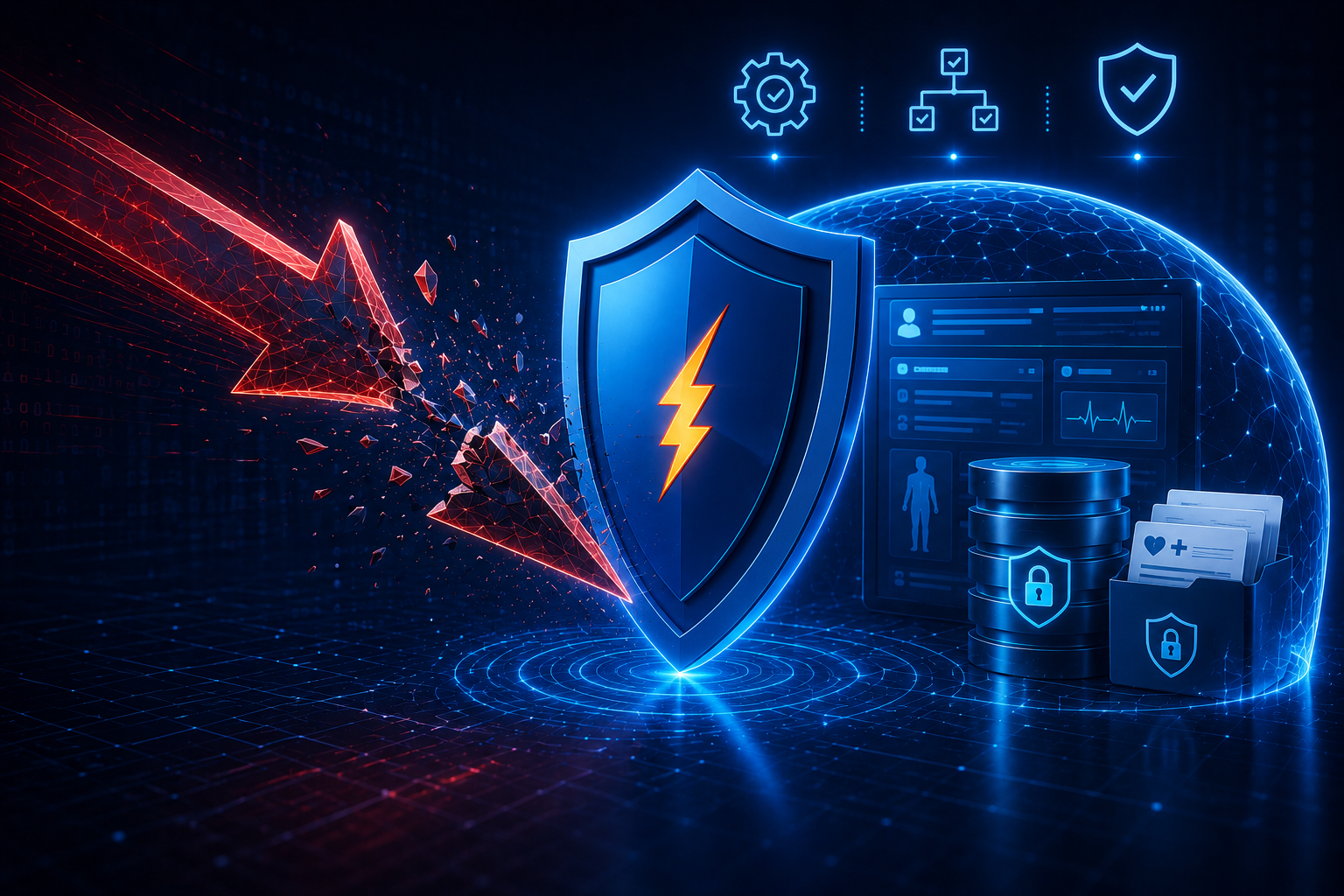
Electronic Medical Records have become the operational backbone of modern healthcare.
Whether a patient is seen in a hospital, physician practice, community health center, home healthcare agency, behavioral health organization, or specialty clinic, care depends on the availability of digital information. Schedules, medication lists, treatment plans, physician notes, referrals, laboratory results, imaging records, billing workflows, and patient communications all flow through interconnected systems.
Healthcare organizations no longer document care after it happens.
Technology has become part of how care is delivered.
That reality creates a challenge.
As healthcare organizations become more dependent on EMRs, those systems become more attractive targets for cybercriminals. A successful ransomware attack, compromised endpoint, or exploited vulnerability can disrupt access to critical information at the exact moment clinicians need it most.
The impact is not limited to IT.
When an EMR becomes unavailable, appointments may be delayed. Clinical workflows may slow down. Staff may revert to manual processes. Revenue cycle operations may be interrupted. Patients may lose confidence. Regulators may ask difficult questions.
Most importantly, care delivery may be affected.
This is why EMR security can no longer be viewed as a technical project managed exclusively by the IT department.
It is a business continuity issue.
It is a patient safety issue.
It is a leadership issue.
Why EMRs Have Become Prime Targets
Healthcare continues to experience some of the most aggressive cyber threats of any sector.
The reason is simple.
Healthcare organizations possess valuable data, operate complex technology environments, and often cannot tolerate prolonged downtime. Threat actors understand that healthcare organizations face tremendous pressure to restore operations quickly after an incident.
As a result, attackers frequently target the systems that matter most.
EMRs sit at the center of that reality.
A compromised workstation may be inconvenient. A compromised EMR environment can become an organizational crisis.
The Department of Health and Human Services has repeatedly emphasized that cybersecurity failures can affect patient safety, operational continuity, and the availability of healthcare services. Through its Health Industry Cybersecurity Practices (HICP) guidance, HHS identifies vulnerability management, endpoint protection, asset management, and network management among the foundational practices healthcare organizations should prioritize.
The message is clear.
Healthcare organizations must assume that attacks will continue.
The question is not whether attackers are interested in healthcare.
The question is whether healthcare organizations are prepared.
Security Begins Long Before an Attack
Many organizations focus on incident response.
That is understandable.
Cybersecurity incidents receive attention because they are visible.
Ransomware makes headlines.
Breaches trigger investigations.
Downtime creates urgency.
But the strongest healthcare organizations focus on something less visible.
Preparation.
Long before a phishing email is opened or a vulnerability is exploited, organizations make decisions that determine how resilient their EMR environment will be during a crisis.
This is one of the reasons the National Institute of Standards and Technology (NIST) Cybersecurity Framework places Govern and Identify before Protect, Detect, Respond, and Recover.
That sequence matters.
Many organizations rush toward security tools and incident response planning without first establishing governance, understanding their environment, identifying critical assets, mapping data flows, and assessing risk.
Yet effective cybersecurity begins with visibility.
You cannot protect systems you have not identified.
You cannot prioritize vulnerabilities if you do not know which assets support patient care.
You cannot build resilience if leadership lacks clear accountability for cybersecurity decisions.
For healthcare organizations, Govern means establishing oversight, accountability, policies, risk management processes, and leadership involvement. Identify means understanding the systems, devices, applications, vendors, users, and data that support clinical and business operations.
These foundational activities are often overlooked because they are less visible than responding to an attack.
That is a mistake.
Organizations that struggle during cyber incidents frequently discover that the root cause was not the absence of a security tool. It was the absence of visibility, governance, or asset awareness.
Once those foundations are established, healthcare organizations can focus on strengthening the technical controls that help protect critical systems.
Three of the most important controls involve:
Patching
Network segmentation
Endpoint defense
These controls are not new.
Yet they remain among the most effective ways to reduce cyber risk.
When implemented within a strong governance and asset management framework, they make it significantly more difficult for attackers to gain access, move through the environment, and compromise critical systems.
Patching: Closing the Doors Attackers Already Know About
Many healthcare breaches do not begin with sophisticated techniques.
They begin with known vulnerabilities.
In many cases, attackers exploit weaknesses that already have available fixes.
That is why patch management remains one of the most important cybersecurity disciplines in healthcare.
The challenge is that healthcare environments are complicated.
EMRs often integrate with billing systems, laboratory platforms, imaging applications, patient portals, medical devices, cloud services, and third-party vendors. Organizations may hesitate to apply updates because they fear disrupting clinical operations.
That hesitation is understandable.
But unpatched systems create risk.
The Cybersecurity and Infrastructure Security Agency (CISA) has repeatedly stated that timely patching is one of the most efficient and cost-effective actions organizations can take to reduce cyber exposure. CISA has specifically advised organizations to prioritize known exploited vulnerabilities and internet-facing systems because attackers actively target these weaknesses.
For healthcare leaders, the issue is not simply whether updates are installed.
The issue is whether there is a repeatable process.
Questions leadership should ask include:
Do we maintain an inventory of systems supporting our EMR?
Do we know which systems are internet-facing?
How quickly are critical vulnerabilities reviewed?
Who approves emergency patching?
Are unsupported systems still in operation?
How do we test updates before deployment?
Organizations that cannot answer these questions often discover weaknesses during an incident rather than before one.
That is dangerous.
Patching is not glamorous.
But it remains one of the most effective ways to reduce the likelihood of compromise.
Network Segmentation: Preventing a Molehill from Becoming a Mountain
Many healthcare networks were not designed with modern cyber threats in mind.
Over time, systems were added.
Applications were integrated.
Vendors were connected.
Remote access expanded.
Cloud services were adopted.
The result is often a highly connected environment where a compromise in one area can spread rapidly into another.
This is where network segmentation becomes critical.
Segmentation limits how far an attacker can travel after gaining access.
Rather than allowing unrestricted movement across the environment, segmentation creates boundaries between systems, departments, users, and critical assets.
Think of it as fire containment.
A fire that starts in one room is dangerous.
A fire that spreads throughout an entire building becomes catastrophic.
Cyber incidents behave in much the same way.
CISA has consistently recommended network segmentation as a key defense against ransomware and lateral movement. The agency notes that segmentation helps contain intrusions and limits an attacker's ability to move between systems after initial access.
For healthcare organizations, segmentation may include separating:
Clinical systems from administrative systems
EMR infrastructure from user workstations
Medical devices from business networks
Backup environments from production environments
Vendor access from internal operations
The goal is not complexity.
The goal is containment.
A successful attack should not automatically become an enterprise-wide outage.
Endpoint Defense: Protecting the Front Lines
Every healthcare organization has endpoints.
Laptops.
Desktop computers.
Tablets.
Mobile devices.
Clinical workstations.
Remote devices used by employees and contractors.
These endpoints are where people interact with systems every day.
They are also where many attacks begin.
A phishing email reaches an employee.
A malicious attachment is opened.
A credential is stolen.
A browser vulnerability is exploited.
The endpoint often becomes the first battlefield.
HHS cybersecurity guidance identifies endpoint protection as a foundational cybersecurity practice because endpoints remain one of the most common paths attackers use to gain access to healthcare environments.
Modern endpoint defense extends beyond traditional antivirus software.
Healthcare organizations should evaluate:
Application control
Device encryption
Privileged access management
CISA has specifically highlighted EDR capabilities as valuable for identifying suspicious activity and detecting lateral movement before attacks escalate.
The objective is simple.
Detect threats early.
Contain them quickly.
Prevent them from reaching critical systems.
The Real Message for Healthcare Leaders
Patching, segmentation, and endpoint defense are often discussed as technical controls.
That is a mistake.
These are operational controls.
They help determine whether clinicians can access records.
They help determine whether appointments proceed as scheduled.
They help determine whether billing continues.
They help determine whether patients receive uninterrupted care.
Healthcare organizations spend significant time discussing innovation, digital transformation, interoperability, and patient experience.
Those conversations matter.
But none of those goals can succeed if critical systems cannot be trusted, protected, or recovered.
The strongest healthcare organizations understand that cybersecurity is no longer separate from operations.
Cyber resilience has become part of healthcare resilience.
And EMR security has become part of patient care.
Healthcare depends on digital systems.
Those systems must be protected.
Is Your EMR Environment Ready for Today's Cyber Threats?
ShieldForce helps healthcare organizations strengthen cyber resilience across EMR platforms, endpoints, networks, cloud environments, user access controls, backup systems, and third-party integrations. Our Healthcare Cyber Readiness Assessment provides healthcare leaders with a practical understanding of where vulnerabilities exist, how cyber risks could affect clinical operations, and what steps should be prioritized to strengthen security and operational continuity.
Whether you are preparing for a security assessment, cyber insurance renewal, compliance review, ransomware defense initiative, or broader cybersecurity modernization effort, ShieldForce can help you identify gaps, reduce risk, and build a more resilient healthcare environment.
Schedule a complimentary Healthcare Cyber Readiness Assessment with ShieldForce today. Let us help your organization protect patient information, strengthen EMR security, improve operational resilience, and build a practical roadmap for secure and sustainable growth.