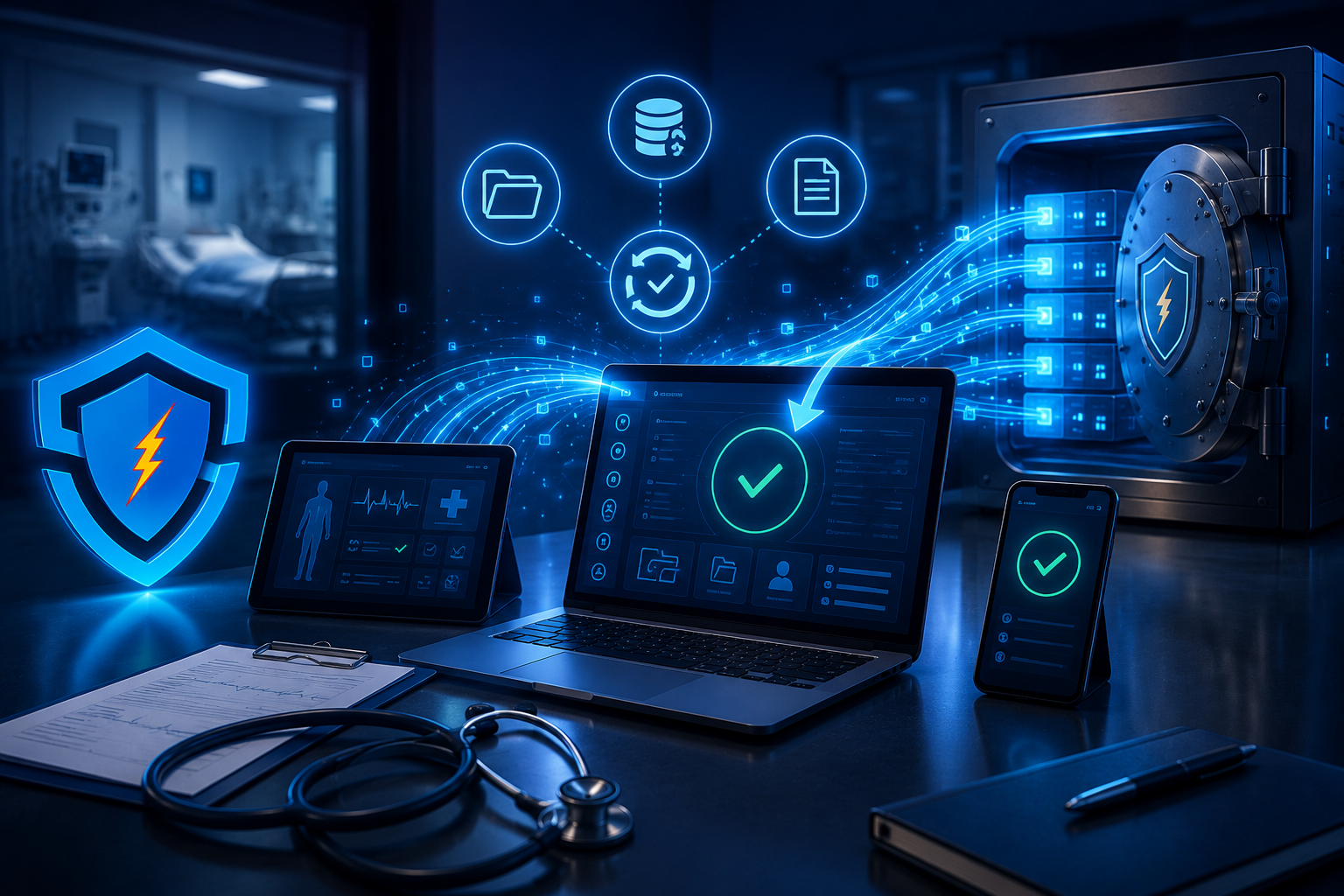
Most healthcare organizations believe they have backups.
Far fewer know whether those backups will actually restore when it matters most.
That distinction matters.
A backup that cannot be restored is not a backup.
It is a false sense of security.
Healthcare leaders often focus on preventing cyberattacks. That is understandable. No organization wants to experience ransomware, data loss, or operational disruption.
But cybersecurity is not only about prevention.
It is also about recovery.
Because eventually, every organization faces some form of disruption. It may be ransomware. It may be accidental deletion. It may be hardware failure. It may be a cloud outage. It may be a natural disaster. It may be a vendor incident.
The question is not whether something can go wrong.
The question is whether your organization can recover when it does.
This is where disaster recovery becomes a business issue, a patient care issue, and a leadership issue.
The Most Dangerous Backup Is the One You Have Never Tested
Many organizations assume backups are working because backup software reports a successful job.
That assumption can be expensive.
Files may be corrupted.
Permissions may be missing.
Critical databases may not be included.
Recovery procedures may be outdated.
Backup administrators may no longer work for the organization.
Organizations often discover these problems during a crisis.
That is the worst possible time to learn that your recovery plan exists only on paper.
A successful backup is not proof of recoverability.
A successful restoration is.
Healthcare leaders should ask a simple question:
"If our primary systems became unavailable today, how quickly could we restore them?"
Many organizations do not know the answer.
Universal Health Services Ransomware Attack
In September 2020, Universal Health Services (UHS), one of the largest healthcare systems in the United States, experienced a major ransomware attack widely associated with the Ryuk ransomware group. The attack disrupted systems across hundreds of facilities, forced staff to rely on downtime procedures, and created widespread operational challenges. Staff reverted to paper-based processes while systems were restored. UHS later confirmed that established backup processes and offline documentation procedures helped facilities continue delivering care while recovery efforts were underway.
That is an important lesson.
When technology fails, patient care cannot fail with it.
Organizations often focus on the moment of compromise.
The more important question is what happens next.
Can clinicians continue documenting care?
Can staff access patient information?
Can scheduling continue?
Can billing continue?
Can operations function while systems are being restored?
UHS reportedly spent months recovering from the incident, with recovery costs and lost revenue reaching tens of millions of dollars.
The attack was severe.
But recovery capabilities helped prevent a difficult situation from becoming worse.
The Illinois Hospital Closure Is an Even Bigger Warning
Some healthcare organizations do not recover as successfully.
In 2023, St. Margaret's Health in Illinois announced it would close, citing several financial challenges, including the long-term impact of a ransomware attack that occurred in 2021. Hospital leaders stated that the attack disrupted operations and prevented claims from being submitted for months, contributing to significant financial strain. Multiple reports described it as the first known hospital closure publicly linked in part to a ransomware attack.
Think about what that means.
This was not simply an IT problem.
It became a business continuity problem.
A financial problem.
A patient access problem.
A community problem.
Cyber incidents rarely end when the ransomware note appears.
The true cost often emerges during the recovery period.
Organizations that cannot restore operations quickly may experience weeks or months of disruption.
Revenue stops.
Claims stop.
Productivity drops.
Patient confidence suffers.
Recovery delays become business risks.
Availability Is Just as Important as Confidentiality
Healthcare cybersecurity conversations often focus on data breaches.
Patient privacy is critically important.
But availability matters too.
I guess that's why it ends the CIA triad, saving the best for last.
A perfectly secure system that cannot be restored during an outage is still a problem.
The HIPAA Security Rule has always emphasized the confidentiality, integrity, and availability (CIA triad) of electronic protected health information.
Availability is frequently the least discussed of the three.
That needs to change.
Healthcare organizations depend on access to information.
When systems become unavailable, operations slow down immediately.
Clinical workflows are disrupted.
Communication becomes difficult.
Administrative processes stall.
Patient care becomes harder.
This is why disaster recovery should never be viewed as a technical exercise alone.
It is part of operational resilience.
You Can Never Go Wrong With a Little Redundancy
One of the most common lessons learned after major cyber incidents is that organizations often rely too heavily on a single system, a single backup platform, or a single recovery method.
That creates unnecessary risk.
You can never go wrong with a little redundancy.
Redundancy is not waste.
Redundancy is resilience.
If one backup fails, another should exist.
If one storage location becomes unavailable, another should remain accessible.
If one recovery path breaks, another should be available.
This is why many organizations adopt multiple layers of protection, including local backups, cloud backups, offline backups, immutable storage, and documented downtime procedures.
The goal is simple.
Never allow a single point of failure to become a single point of disaster.
Cloud services are not "Backup" platforms
Many organizations assume that because they use Microsoft 365 or Google Workspace, their data is fully protected.
That assumption can create dangerous blind spots.
Email, SharePoint, OneDrive, Teams, Google Drive, Gmail, Calendars, and shared files often contain critical operational and patient-related information. Accidental deletion, ransomware, malicious insiders, synchronization errors, and compromised administrator accounts can all result in data loss that native retention features were never designed to fully address. Microsoft itself distinguishes between service availability and backup responsibilities, emphasizing the importance of recovery capabilities when data is lost or corrupted.
That matters.
Because during a ransomware incident, organizations are not only trying to recover servers and endpoints.
They are trying to recover communication.
Scheduling.
Documentation.
Shared files.
Email.
Collaboration platforms.
The systems people depend on every day.
This is why healthcare organizations should evaluate whether their Microsoft 365 and Google Workspace environments are backed up independently from the platforms themselves. ShieldForce provides dedicated backup and recovery services for both environments, including immutable storage, rapid recovery options, and protection against accidental deletion, ransomware, and administrative mistakes.
Learn more:
Because when recovery becomes necessary, the question is not whether the data existed yesterday.
The question is whether you can restore it today.
What Healthcare Leaders Should Verify Today
Every healthcare organization should be able to answer several questions immediately.
Are our critical systems backed up?
Do we know exactly what is being backed up?
Are backups encrypted?
Are backups protected from ransomware?
Can attackers delete our backups?
Have we tested restoration within the last 12 months?
How long would a full restoration take?
Who owns the recovery process?
Do we have documented recovery procedures?
Can we operate manually during extended downtime?
Do department leaders understand their responsibilities during a recovery event?
If leadership cannot confidently answer these questions, there may be gaps that require attention.
Recovery Time Matters More Than Backup Size
Organizations sometimes focus on how much data they have backed up.
A more important metric is how quickly they can restore it.
A backup that takes two weeks to restore may not support operational requirements.
A backup that restores within hours may significantly reduce disruption.
This is why healthcare organizations should define recovery objectives before an incident occurs.
Which systems must return first?
Which systems can wait?
How much downtime is acceptable?
How much data loss is acceptable?
These decisions should not be made during a ransomware event.
They should be made long before one occurs.
Tabletop Exercises Reveal the Truth
Many organizations test backups.
Fewer test decision-making.
Both are necessary.
A tabletop exercise allows leadership to walk through a realistic ransomware scenario.
Who makes decisions?
Who contacts vendors?
Who contacts cyber insurance?
Who communicates with staff?
Who authorizes recovery activities?
Who determines whether patient information was affected?
The exercise often reveals gaps that documentation alone cannot identify.
That matters.
Because confusion during an incident creates delays.
Delays increase costs.
Delays increase risk.
The Real Message for Healthcare Leaders
Disaster recovery is no longer a technical afterthought.
It is a core business function.
The healthcare organizations that recover fastest are not always the organizations with the largest budgets.
They are often the organizations that prepared.
They know where their data lives.
They know how to restore it.
They have tested their backups.
They have documented their procedures.
They have practiced their response.
The ransomware attack at UHS demonstrated the importance of established backup and downtime processes.
The closure of St. Margaret's Health demonstrated the devastating consequences that can follow prolonged operational disruption.
Different outcomes.
The same lesson.
Backups are not measured by whether they exist.
They are measured by whether they restore.
When the day comes that systems fail, ransomware strikes, or a critical outage occurs, nobody will ask how many backup reports showed "successful."
They will ask one question.
Can we recover?
The organizations that can answer "yes" will be the ones best positioned to protect operations, maintain patient trust, and continue delivering care when it matters most.
When patient care is on the line, backups are only as valuable as their ability to restore quickly and reliably. Healthcare organizations need more than backup storage; they need a proven disaster recovery strategy that minimizes downtime, protects critical data, and keeps clinical operations running when the unexpected happens.
ShieldForce helps healthcare providers build resilient, recovery-ready environments with secure backup solutions, regular recovery testing, and expert support tailored to healthcare compliance and operational requirements.
Ready to strengthen your disaster recovery posture? Contact ShieldForce today to assess your backup and recovery strategy and ensure your organization can recover with confidence when it matters most.