
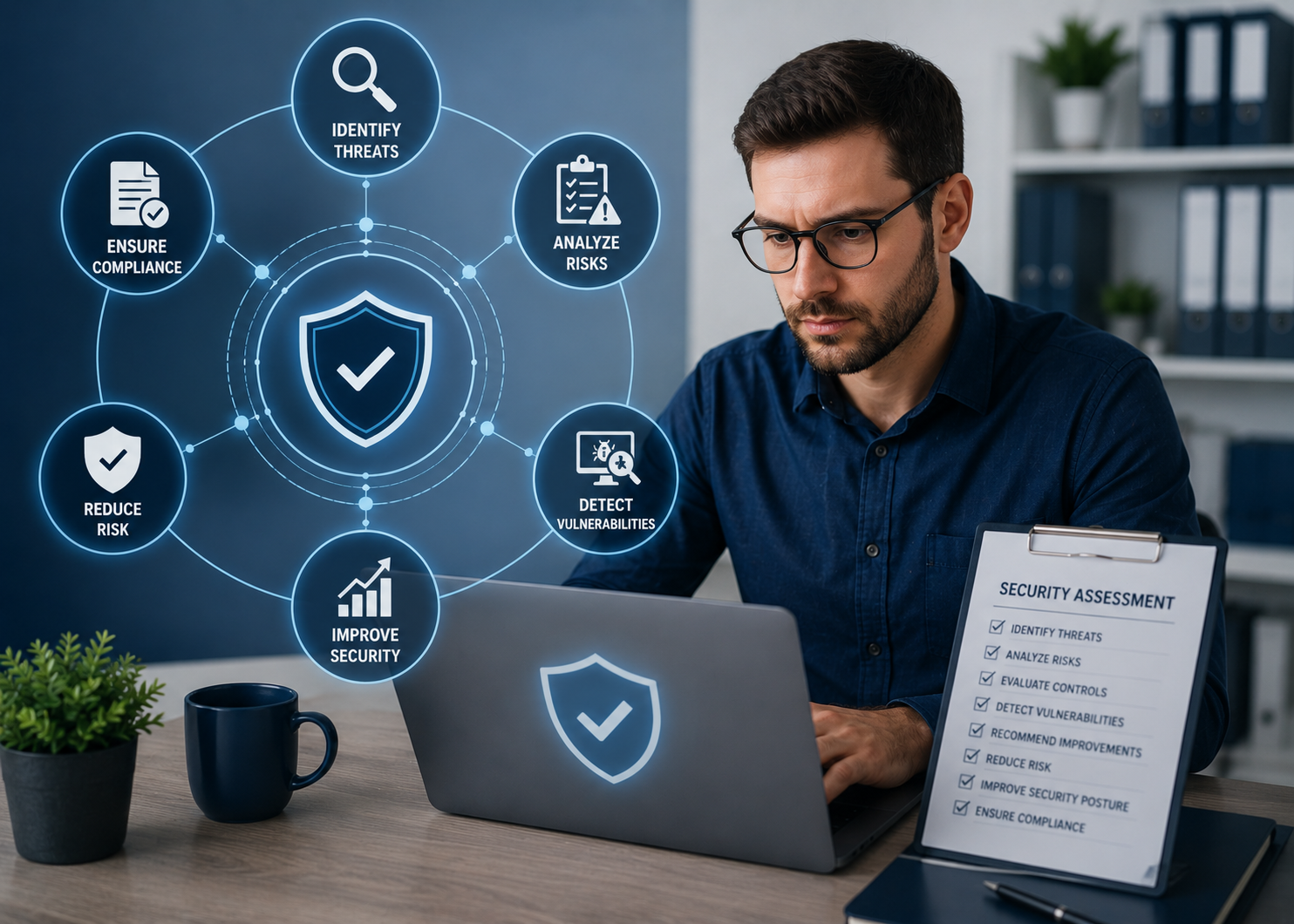
Cyber threats are no longer occasional events that only affect large enterprises. They have become part of the daily operating environment for businesses of every size.
Attackers move faster. Ransomware groups automate campaigns. Employees work from multiple locations. Cloud platforms expand rapidly. Third-party vendors connect directly into business operations. New vulnerabilities appear continuously.
That means security is no longer something a business configures once and forgets.
It must be evaluated continuously.
This is why regular security assessments have become critical for modern businesses.
A company may believe its systems are secure because antivirus software is installed, firewalls are active, and passwords are required. But cybersecurity gaps rarely appear in obvious places. They emerge quietly over time through misconfigured cloud settings, outdated software, excessive user permissions, weak vendor controls, unmanaged devices, and human error.
Most organizations do not realize how exposed they are until after an incident occurs.
By then, the cost is much higher.
Security Assessments Are About Visibility
One of the biggest cybersecurity risks for any business is not knowing where vulnerabilities exist.
You cannot protect what you cannot see.
Over time, businesses add:
new employees,
new devices,
new cloud applications,
new vendors,
remote access tools,
collaboration platforms,
and operational systems.
Each addition changes the organization’s risk profile.
A regular security assessment helps leadership understand:
what systems exist,
where sensitive data lives,
who has access,
which controls are missing,
and which vulnerabilities create the highest operational risk.
Without this visibility, businesses often operate with a false sense of security.
That is dangerous.
Cybersecurity Weaknesses Change Constantly
A security posture that looked acceptable six months ago may now contain serious gaps.
Software changes.
Employees leave.
New devices connect.
Threat actors evolve tactics.
Business operations expand.
Cloud platforms introduce new features and risks.
Cybersecurity is not static.
For example:
an inactive employee account may still have access to company systems,
a backup may stop running without anyone noticing,
a critical patch may never be applied,
or a vendor integration may expose sensitive information unexpectedly.
These issues are common across small and mid-sized businesses.
Regular assessments help organizations identify problems before attackers do.
Small Gaps Often Become Large Incidents
Many cyber incidents begin with a very small oversight.
A weak password.
A missing software update.
An unprotected remote access account.
A phishing email opened by an employee.
A laptop without encryption.
A cloud folder shared incorrectly.
Individually, these may seem minor.
But attackers look for exactly these types of weaknesses because they are often the easiest entry points into a business.
Once inside, the consequences can expand quickly:
operational downtime,
ransomware encryption,
financial fraud,
customer notification costs,
legal exposure,
reputational damage,
and loss of business trust.
A regular security assessment helps reduce the likelihood that a small issue becomes a major business disruption.
Cybersecurity Is No Longer Just an IT Responsibility
Many organizations still treat cybersecurity as something handled only by the IT department.
But the consequences of a cyber incident affect the entire business.
A ransomware attack can interrupt operations.
A breach can damage customer confidence.
An outage can stop revenue-generating activity.
A compliance failure can trigger penalties.
A vendor compromise can disrupt service delivery.
This is why security assessments should be viewed as business risk assessments, not simply technical reviews.
Leadership needs to understand:
where the organization is vulnerable,
what the operational impact could be,
and which risks require immediate attention.
Cybersecurity has become part of operational resilience.
Compliance Expectations Continue to Increase
Across industries, regulatory expectations are becoming more demanding.
Healthcare organizations face HIPAA obligations.
Financial institutions face data protection requirements.
Retailers handle payment card information.
Professional service firms manage confidential client data.
Government contractors face stricter cybersecurity standards.
Insurance providers increasingly require evidence of security controls.
In many cases, organizations are expected to demonstrate reasonable safeguards, not simply claim they exist.
That evidence may include:
vulnerability assessments,
risk analysis documentation,
access control reviews,
backup testing,
incident response planning,
security awareness training,
and vendor oversight processes.
A regular assessment helps businesses maintain documentation, improve accountability, and prepare for audits, insurance reviews, or client security questionnaires.
It also helps organizations identify compliance gaps before regulators or customers do.
Remote Work Expanded the Attack Surface
The modern workforce no longer operates entirely inside a single office.
Employees work remotely.
Teams use cloud collaboration platforms.
Staff connect through home Wi-Fi networks.
Mobile devices access sensitive systems from multiple locations.
This flexibility improves business operations, but it also creates additional exposure.
A business may now have:
unmanaged personal devices,
inconsistent patching,
weak remote access controls,
unsecured public Wi-Fi usage,
or excessive permissions across cloud applications.
That creates a very different security environment than traditional office infrastructure.
Regular security assessments help businesses evaluate whether their controls still match how employees actually work today.
Because if the business changed but the security strategy did not, risk usually increases.
Vendor Risk Is Business Risk
Most organizations depend heavily on third-party vendors.
Cloud providers, payroll companies, IT consultants, software platforms, marketing agencies, payment processors, and managed service providers often have access to sensitive systems or business data.
That means a vendor’s cybersecurity weakness can become your problem very quickly.
Businesses should understand:
which vendors have access to sensitive information,
how that access is controlled,
whether vendors use MFA,
how incidents are reported,
and whether vendors maintain reasonable security practices.
A regular security assessment helps organizations evaluate these relationships more carefully.
This is especially important because many modern cyber incidents spread through interconnected systems and trusted vendor relationships.
Security Assessments Improve Decision-Making
One overlooked benefit of regular security assessments is better operational decision-making.
Assessments help leadership prioritize resources more effectively.
Instead of reacting emotionally after an incident, organizations can:
identify the highest-risk areas,
focus budgets strategically,
strengthen the most important safeguards,
and build long-term resilience systematically.
This creates operational discipline.
Businesses that assess their environments regularly are usually better prepared for:
cyber insurance renewals,
customer due diligence requests,
regulatory scrutiny,
vendor onboarding,
and incident response situations.
Preparation reduces chaos.
Incident Response Starts Before an Incident
One of the clearest signs of a mature organization is whether it prepares before a crisis occurs.
A security assessment does more than identify vulnerabilities. It helps businesses understand:
how quickly threats could spread,
which systems are critical,
who needs to respond,
and where operational dependencies exist.
That preparation becomes extremely important during a real-world event.
When organizations lack visibility, incidents often become more expensive because teams lose valuable time trying to understand systems, permissions, backups, vendors, and communication processes during the crisis itself.
The first hours of a cyber incident matter.
Preparation matters too.
What Businesses Should Evaluate Regularly
A strong security assessment should examine both technical and operational risks.
That includes areas such as:
endpoint protection,
email security,
cloud configurations,
user access controls,
MFA deployment,
backup integrity,
patch management,
vendor access,
remote work exposure,
employee awareness,
incident response readiness,
and data protection practices.
It should also reflect how the organization actually operates.
A generic checklist is not enough.
The assessment must align with:
the company’s workflows,
regulatory obligations,
operational priorities,
staffing realities,
and technology environment.
The Real Value of Regular Security Assessments
The goal of a security assessment is not perfection.
It is awareness, prioritization, and continuous improvement.
Businesses do not become resilient by assuming they are secure.
They become resilient by identifying weaknesses early, addressing risks systematically, and adapting as operations evolve.
The organizations that assess themselves regularly are usually better positioned to:
reduce downtime,
protect customer trust,
strengthen compliance readiness,
improve operational continuity,
and respond more effectively when incidents occur.
The organizations that avoid assessments often discover problems under pressure — after a breach, ransomware attack, failed audit, or operational disruption forces the conversation.
Cyber threats will continue evolving.
Business environments will continue changing.
Security assessments help ensure that protection evolves too.
For modern businesses, that is no longer optional.
At ShieldForce, we help businesses evaluate cybersecurity risks across users, devices, cloud platforms, email systems, backups, vendor access, remote work environments, and critical business operations.
Our security assessments provide leadership teams with practical visibility into where they are exposed today, what risks require immediate attention, and how to build a stronger foundation for long-term resilience.
Schedule a complimentary cybersecurity assessment with ShieldForce today and take the first step toward strengthening your business against evolving cyber threats before an incident forces the conversation.