
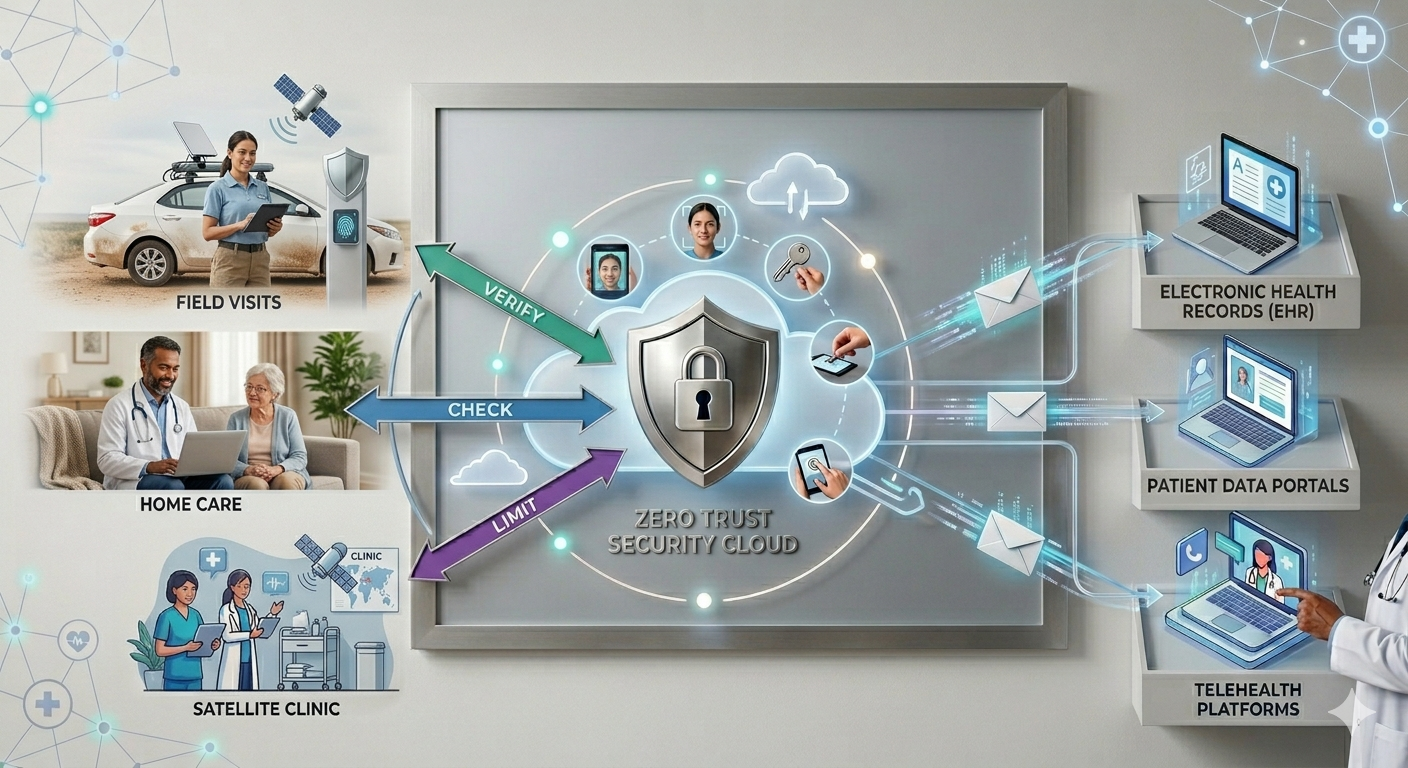
Healthcare work is no longer tied to a single building.
Care teams now move constantly between patient homes, clinics, assisted living communities, rehabilitation facilities, physician offices, and remote work environments. Nurses document visits from tablets. Coordinators access scheduling systems from laptops at home. Administrators review patient information from cloud platforms across multiple offices. Caregivers communicate through mobile devices while traveling between visits.
Modern healthcare operations have become mobile.
But mobility changes risk.
Every time a staff member connects to an application from a new location, uses a personal device, logs into a cloud platform, accesses patient information from public Wi-Fi, or shares information across systems, the traditional security boundary becomes weaker.
There is no longer one office perimeter to defend.
That is why Zero Trust security has become increasingly important for healthcare organizations with distributed and mobile workforces.
For home healthcare agencies, hospice providers, behavioral health organizations, community healthcare programs, and multi-site healthcare operators, Zero Trust is no longer just an enterprise cybersecurity concept. It is becoming a practical operational framework for protecting electronic protected health information, reducing ransomware exposure, strengthening workforce security, and maintaining visibility across a highly mobile care environment.
The reality is simple: healthcare mobility requires a different security model.
The Traditional Security Model No Longer Fits Mobile Healthcare
For many years, organizations approached cybersecurity like a castle.
If users and devices were inside the network, they were trusted. If they were outside, they were treated as threats.
That model worked better when:
most employees worked in one office,
systems were hosted internally,
devices stayed onsite,
and applications rarely moved beyond the corporate network.
Healthcare operations no longer work that way.
Today, mobile care teams rely heavily on:
cloud-based EMRs,
mobile scheduling platforms,
electronic visit verification systems,
collaboration tools,
remote access applications,
cloud email,
payer portals,
mobile messaging,
and third-party healthcare platforms.
Patient information now moves continuously across:
people,
devices,
applications,
locations,
and vendors.
That changes the threat landscape completely.
A nurse may access patient records from a patient's home in the morning, complete documentation from a tablet in a vehicle between visits, review messages from a personal phone during lunch, and connect to agency systems from home later in the evening.
Every connection point becomes a potential attack surface.
This is why healthcare organizations can no longer assume that a user, device, or session should automatically be trusted simply because it successfully logged in once.
Trust must become conditional.
What Zero Trust Actually Means
Zero Trust is often misunderstood as a product.
It is not.
Zero Trust is a security approach based on a simple principle:
Never trust automatically. Always verify continuously.
In practical terms, Zero Trust assumes:
users can be compromised,
devices can be compromised,
credentials can be stolen,
sessions can be hijacked,
and threats can exist both inside and outside the organization.
Instead of granting broad access after one login, Zero Trust focuses on:
identity verification,
device validation,
least-privilege access,
continuous monitoring,
segmentation,
and controlled access to systems and data.
For healthcare organizations, this means access decisions are based not only on a password, but also on:
who the user is,
what device they are using,
where they are connecting from,
whether the device is secured,
what application they are accessing,
and whether the behavior appears normal.
That matters because attackers increasingly target healthcare organizations through stolen credentials, phishing attacks, weak remote access controls, and compromised endpoints.
A valid username and password are no longer enough to establish trust.
Mobile Care Teams Create Unique Security Challenges
Mobile healthcare operations create complexity that many traditional security models were not designed to handle.
Unlike centralized office environments, home healthcare and distributed care teams operate across constantly changing environments.
Staff may:
connect through home Wi-Fi,
use public internet connections,
travel between locations,
use agency-owned and personal devices,
share information across multiple platforms,
and access systems outside standard business hours.
This creates visibility challenges.
Leadership may not fully know:
which devices are accessing ePHI,
which applications staff are using,
where sensitive information is stored,
whether endpoints are patched,
or whether unauthorized access is occurring.
The operational pace of healthcare also increases risk.
Care teams prioritize patient care first. That is understandable. But in fast-moving environments, staff may:
reuse passwords,
bypass security procedures,
store information improperly,
delay software updates,
or use unauthorized communication methods for convenience.
These behaviors are common in distributed workforces.
The problem is not usually malicious intent.
The problem is operational exposure.
Zero Trust helps reduce that exposure by limiting unnecessary access and strengthening verification throughout the environment.
Identity Becomes the New Security Perimeter
In a mobile healthcare environment, identity becomes one of the most important control points.
Organizations can no longer rely primarily on office networks to determine trust. Instead, they must focus on validating the user and the conditions surrounding access.
This is why identity security is central to Zero Trust.
For healthcare organizations, strong identity protection should include:
multi-factor authentication,
role-based access controls,
conditional access policies,
account monitoring,
privileged access management,
and rapid deprovisioning for former employees.
This is especially important in healthcare because workforce turnover can be high and staff responsibilities frequently change.
If a former employee still has access to systems, that creates unnecessary risk.
If administrative privileges are excessive, that creates unnecessary exposure.
If MFA is not enabled for remote access and cloud applications, stolen credentials may become a direct path into patient information systems.
Zero Trust helps organizations reduce these risks by ensuring users receive only the access they actually need and by continuously validating trust signals during access attempts.
Device Security Matters More Than Ever
A compromised device can become an entry point into the organization.
For mobile healthcare teams, devices are everywhere:
laptops,
tablets,
smartphones,
home computers,
and field documentation systems.
Some are managed properly.
Some are not.
That inconsistency creates risk.
A Zero Trust approach treats device security as part of the access decision itself.
For example:
Is the device encrypted?
Is endpoint protection active?
Is the operating system updated?
Is the device jailbroken or compromised?
Is the device managed by the organization?
Has suspicious activity been detected?
If the answer raises concern, access can be restricted or blocked automatically.
This becomes extremely valuable for healthcare organizations with distributed workforces because it reduces the likelihood that an infected or unmanaged device gains unrestricted access to sensitive systems.
In practical terms, device trust becomes dynamic rather than assumed.
Least-Privilege Access Reduces Operational Exposure
One of the most important principles within Zero Trust is least-privilege access.
Users should only have access to the systems, applications, and data necessary for their responsibilities.
Nothing more.
This sounds simple, but many healthcare organizations struggle with excessive access permissions.
Over time:
employees change roles,
temporary access becomes permanent,
shared accounts remain active,
vendors retain unnecessary privileges,
and legacy permissions accumulate.
Eventually, organizations lose visibility into who can access what.
That creates unnecessary exposure.
If an attacker compromises one account, broad access rights may allow the attacker to move deeper into systems and access larger amounts of patient information.
Zero Trust reduces this risk by limiting lateral movement.
A scheduler should not automatically have access to financial systems.
A field caregiver may not require administrative access.
A third-party vendor should not retain unrestricted access after a project ends.
Access should align with operational necessity.
This improves both security and governance discipline.
Continuous Monitoring Helps Detect Abnormal Activity
One of the major weaknesses of older security models is that trust is often granted once and maintained indefinitely.
Zero Trust changes that.
Access decisions become ongoing rather than static.
For example, security systems may detect:
impossible travel activity,
unusual login times,
large data transfers,
repeated failed authentication attempts,
unauthorized applications,
or suspicious endpoint behavior.
If activity appears abnormal, organizations can:
require additional authentication,
restrict access,
isolate devices,
or trigger investigation workflows.
This is particularly important for healthcare because ransomware operators often spend time inside environments before launching attacks.
Early visibility matters.
The faster organizations identify suspicious activity, the greater the opportunity to contain operational disruption before patient care systems are affected. This is one reason many healthcare organizations are investing in managed SOC services that provide continuous monitoring, threat detection, and faster incident response across distributed care environments.
Zero Trust Supports HIPAA and Operational Resilience
Zero Trust is not a HIPAA certification framework.
However, many Zero Trust practices align closely with HIPAA Security Rule expectations surrounding:
access controls,
authentication,
workforce security,
device safeguards,
audit controls,
and protection of ePHI.
For healthcare organizations, this alignment matters because regulators increasingly expect organizations to demonstrate practical cybersecurity safeguards rather than rely solely on written policies.
A Zero Trust approach also supports operational resilience.
If a compromised account is isolated quickly, operational disruption may be reduced.
If segmentation limits ransomware movement, downtime may be minimized.
If conditional access blocks risky devices automatically, exposure may be contained before a larger incident develops.
These are not just cybersecurity improvements.
They are continuity protections for patient care operations.
Vendor and Third-Party Access Must Also Be Controlled
Healthcare organizations depend heavily on external vendors.
Billing companies, EMR providers, consultants, IT providers, staffing platforms, scheduling vendors, and support contractors may all require system access.
That creates additional complexity.
Many organizations focus heavily on employee access while overlooking third-party exposure.
Zero Trust principles should apply to vendors as well.
Organizations should know:
which vendors have access,
what systems they can reach,
whether MFA is enabled,
how access is monitored,
when privileges expire,
and whether vendor sessions are logged.
Vendor access should never become permanent simply because it is convenient.
Uncontrolled third-party access creates operational and regulatory risk.
Zero Trust Is a Journey, Not a Single Deployment
One of the biggest misconceptions about Zero Trust is that organizations can “implement Zero Trust” all at once.
In reality, Zero Trust is an ongoing maturity process.
Healthcare organizations do not need to become perfect overnight.
They need progress.
For many mobile healthcare organizations, the first practical steps may include:
enabling MFA across cloud systems,
inventorying devices,
improving endpoint protection,
removing shared accounts,
reviewing user permissions,
strengthening offboarding procedures,
segmenting critical systems,
and improving visibility into remote access activity.
These foundational controls significantly improve security posture even before more advanced Zero Trust capabilities are introduced.
The goal is not complexity for its own sake.
The goal is controlled, verified, and accountable access across a distributed care environment.
ShieldForce helps healthcare organizations assess remote access risks, strengthen identity security, improve endpoint visibility, implement MFA and least-privilege controls, and build practical Zero Trust strategies aligned with modern healthcare operations.
Schedule a complimentary Zero Trust Readiness Assessment with ShieldForce to identify gaps, reduce risk exposure, and create a roadmap for securing today’s mobile care environment.