
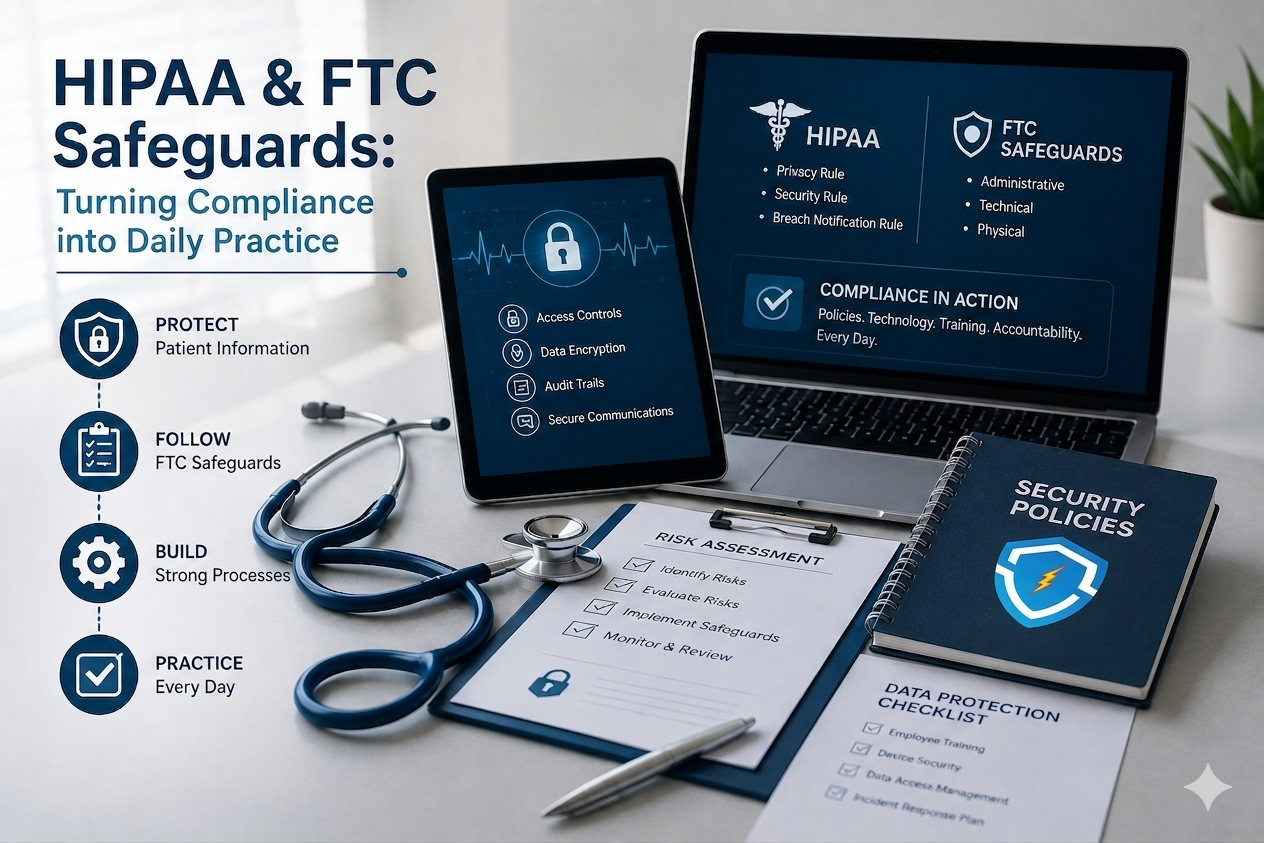
Compliance is often discussed as if it is just documentation.
A policy.
A checklist.
A training certificate.
An annual assessment.
A binder on a shelf.
But regulators do not evaluate compliance based only on what an organization says it intends to do. They increasingly evaluate whether safeguards are actually operating in day-to-day business activities.
That is where many organizations struggle.
The Health Insurance Portability and Accountability Act (HIPAA) and the Federal Trade Commission (FTC) Safeguards Rule both require organizations to protect sensitive information through administrative, technical, and operational controls. Yet many businesses still treat compliance as a periodic event rather than an ongoing operational discipline.
That approach creates risk.
Because in practice, cybersecurity failures rarely happen because an organization lacked a policy document. They happen because safeguards were not consistently followed, reviewed, monitored, enforced, or integrated into everyday operations.
An employee reuses a weak password.
A terminated user account remains active.
A vendor gains unnecessary access.
A phishing email bypasses awareness.
A laptop is left unencrypted.
A backup fails silently.
Sensitive files are shared through insecure channels.
A staff member bypasses procedures to “save time.”
These are daily operational failures.
And increasingly, regulators expect organizations to demonstrate that safeguards exist not only on paper, but in practice.
That is why healthcare organizations, financial service providers, and regulated businesses must shift their mindset.
Compliance is no longer only about documentation.
It is about operational behavior.
Understanding the Overlap
HIPAA and the FTC Safeguards Rule apply to different types of organizations, but they share a common objective: protecting sensitive information from unauthorized access, misuse, loss, or compromise.
HIPAA focuses on protecting protected health information, or PHI, particularly electronic protected health information, or ePHI.
The FTC Safeguards Rule, which applies to many non-bank financial institutions and related organizations, requires companies to develop, implement, and maintain a comprehensive information security program to protect customer information.
Different regulations.
Similar expectations.
Both frameworks emphasize:
risk assessment
access control
workforce training
vendor oversight
incident response
system monitoring
data protection
ongoing governance
documented safeguards
continuous review
This matters because many organizations mistakenly believe compliance is isolated to one department.
It is not.
Security touches operations, leadership, HR, finance, technology, vendor management, and frontline staff activity at the same time.
That is why organizations that approach compliance purely as an IT responsibility often encounter problems later.
Cybersecurity has become an operational function.
Policies Alone Do Not Reduce Risk
Many organizations invest significant time creating policies.
That is important.
But policies alone do not secure systems.
A password policy does not matter if employees continue sharing credentials.
An access control policy does not matter if former staff retain system access.
A vendor management policy does not matter if vendors are never reviewed.
An incident response policy does not matter if nobody knows where it is during an emergency.
This is one of the biggest gaps regulators continue to identify across industries.
Organizations often have documentation.
What they lack is operational consistency.
The difference between theoretical compliance and practical compliance becomes visible during incidents.
After a ransomware attack, regulators may ask:
Was MFA enabled?
Were backups tested?
Were terminated employees removed promptly?
Was sensitive data encrypted?
Was staff training current?
Were security alerts reviewed?
Was vendor access monitored?
Was there evidence of risk analysis and remediation?
Those questions are operational.
They focus on what the organization actually did, not what it intended to do.
That distinction matters.
Compliance Must Be Embedded Into Daily Workflow
The strongest compliance programs are rarely the most complicated.
They are the most consistent.
Organizations reduce risk when safeguards become part of ordinary workflow rather than separate compliance exercises.
For example:
A new employee onboarding process should automatically trigger:
security awareness training
MFA enrollment
device configuration
access approval
acceptable use acknowledgment
An employee termination process should automatically trigger:
account deactivation
badge recovery
remote access review
email forwarding review
vendor credential removal
A vendor onboarding process should trigger:
security review
contract review
access limitation
Business Associate Agreement review where applicable
data handling verification
These processes create operational discipline.
Without discipline, safeguards become inconsistent.
Without consistency, risk grows quietly over time.
Multi-Factor Authentication Is a Daily Control, Not a Technical Feature
Many organizations still view multi-factor authentication, or MFA, as a technical upgrade.
It is more than that.
MFA is now one of the clearest examples of a safeguard that directly reduces organizational exposure.
Passwords alone are no longer sufficient.
Employees reuse passwords.
Credentials are stolen in breaches.
Phishing campaigns target cloud email platforms constantly.
Attackers understand that compromised accounts often provide access to sensitive data, financial systems, and internal communications.
That is why MFA should not be limited to administrators alone.
Organizations should evaluate MFA across:
email systems
cloud storage
remote access platforms
payroll systems
financial systems
healthcare applications
administrative accounts
vendor portals
The goal is not perfection.
The goal is reducing the likelihood that one compromised password becomes a major security incident.
That is practical compliance.
Workforce Training Must Reflect Real-World Behavior
Annual compliance training is rarely enough by itself.
Employees do not operate in annual environments.
They operate in daily environments.
Every day, staff encounter:
suspicious emails
urgent requests
password reset scams
fake invoices
unsafe file-sharing requests
unauthorized disclosure risks
social engineering attempts
pressure to bypass procedures
Training must reflect those realities.
The most effective organizations treat workforce awareness as an ongoing operational function rather than a yearly requirement.
That may include:
recurring reminders
phishing simulations
short security updates
onboarding reinforcement
department-specific guidance
incident reporting education
Most importantly, employees should understand that reporting concerns quickly is encouraged.
A strong security culture does not depend on fear.
It depends on visibility, trust, and rapid communication.
Vendor Risk Has Become a Major Compliance Issue
Organizations increasingly depend on third-party vendors.
Cloud providers.
Payroll companies.
Billing systems.
IT providers.
Document platforms.
Software vendors.
Managed service providers.
Consultants.
Many of these vendors handle sensitive information directly or indirectly.
That means vendor weaknesses can become organizational weaknesses.
This is why HIPAA and the FTC Safeguards Rule both emphasize oversight responsibilities.
Organizations should understand:
what vendors can access
where sensitive data is stored
whether MFA is enabled
how incidents are reported
whether subcontractors are involved
how backups are handled
whether encryption is used
how access is monitored
A signed agreement is important.
But oversight cannot stop at the contract stage.
Vendor management must become an ongoing process.
Risk Assessments Should Reflect Reality
One of the most common compliance weaknesses is incomplete risk assessment.
Some organizations conduct assessments that focus only on technical systems while ignoring operational behavior.
Others rely on outdated assessments that no longer reflect how the business actually functions.
That creates blind spots.
A meaningful risk assessment should evaluate:
systems
devices
cloud platforms
workforce behavior
remote access
vendors
mobile devices
data flow
backup processes
incident response readiness
access control practices
The assessment should reflect the real environment.
Not the ideal environment.
Not the documented environment.
The actual environment.
Because attackers target operational reality, not policy language.
Incident Response Determines How Much Damage Follows an Event
No organization can eliminate all cyber risk completely.
What often determines the severity of an INCIDENT is the quality of the RESPONSE.
When organizations lack a clear incident response process, confusion spreads quickly.
Who receives the initial report?
Who contacts leadership?
Who coordinates with IT?
Who handles legal review?
Who communicates with customers or patients?
Who documents decisions?
Who evaluates regulatory notification obligations?
These decisions become time-sensitive during active incidents.
That is why incident response planning must happen before an event occurs.
A practical incident response plan should address:
phishing
unauthorized access
lost devices
vendor incidents
business email compromise
cloud account compromise
operational outages
Most importantly, the plan should be tested periodically.
A plan that exists only in documentation may fail during real pressure.
Leadership Involvement Is Becoming More Important
One of the biggest shifts in modern cybersecurity regulation is the increasing expectation of leadership accountability.
Compliance can no longer operate entirely in isolation from executive oversight.
Leadership teams should understand:
major organizational risks
critical systems
vendor exposure
backup readiness
workforce security gaps
incident trends
remediation priorities
This does not mean every executive must become a cybersecurity expert.
It means cybersecurity governance must become part of operational governance.
That shift is already happening across healthcare, financial services, and regulated industries.
The direction is clear.
Organizations are increasingly expected to demonstrate not only that safeguards exist, but that leadership understands and supports them.
Turning Compliance Into Daily Practice
Organizations often ask:
“What is the best way to strengthen compliance?”
The answer is usually not a single technology purchase.
It is operational consistency.
Strong compliance programs are built through repeatable habits:
reviewing access regularly
updating systems consistently
training employees continuously
monitoring vendors actively
testing backups periodically
documenting decisions carefully
responding to incidents quickly
reassessing risk routinely
These activities may appear ordinary.
But together, they create resilience.
Compliance becomes sustainable when security practices are integrated into normal business operations rather than treated as separate events.
That is where long-term maturity develops.
The Real Goal of Compliance
The purpose of HIPAA and the FTC Safeguards Rule is not paperwork.
It is trust.
Patients trust healthcare organizations with deeply personal information.
Customers trust businesses with financial and sensitive data.
Organizations trust vendors to operate responsibly.
Communities trust institutions to function reliably.
That trust can be damaged quickly when safeguards fail.
This is why compliance should not be viewed only as a regulatory burden.
It should be viewed as part of operational resilience.
The organizations that understand this early will be better positioned for audits, vendor reviews, cyber insurance requirements, customer expectations, and real-world incidents.
More importantly, they will be better positioned to operate with confidence in an environment where cybersecurity risk continues to grow.
Technology now shapes how organizations deliver service, manage operations, communicate, and store information.
That reality is not temporary.
Compliance must evolve with it.
Policies matter.
But daily practice matters more.
Healthcare organizations can no longer afford to treat HIPAA and FTC Safeguards compliance as a once-a-year exercise. As cyber threats, regulatory expectations, and operational dependencies continue to grow, organizations need practical safeguards that work in real-world environments.
ShieldForce Healthcare Cybersecurity Solutions helps home healthcare agencies, clinics, and regulated healthcare providers strengthen cybersecurity readiness across ePHI workflows, cloud systems, email security, remote access, workforce awareness, vendor oversight, backup, and ransomware resilience. Whether your organization is preparing for a risk assessment, cyber insurance review, compliance initiative, or operational growth, ShieldForce helps turn compliance into a more consistent, resilient, and operationally sustainable security program.