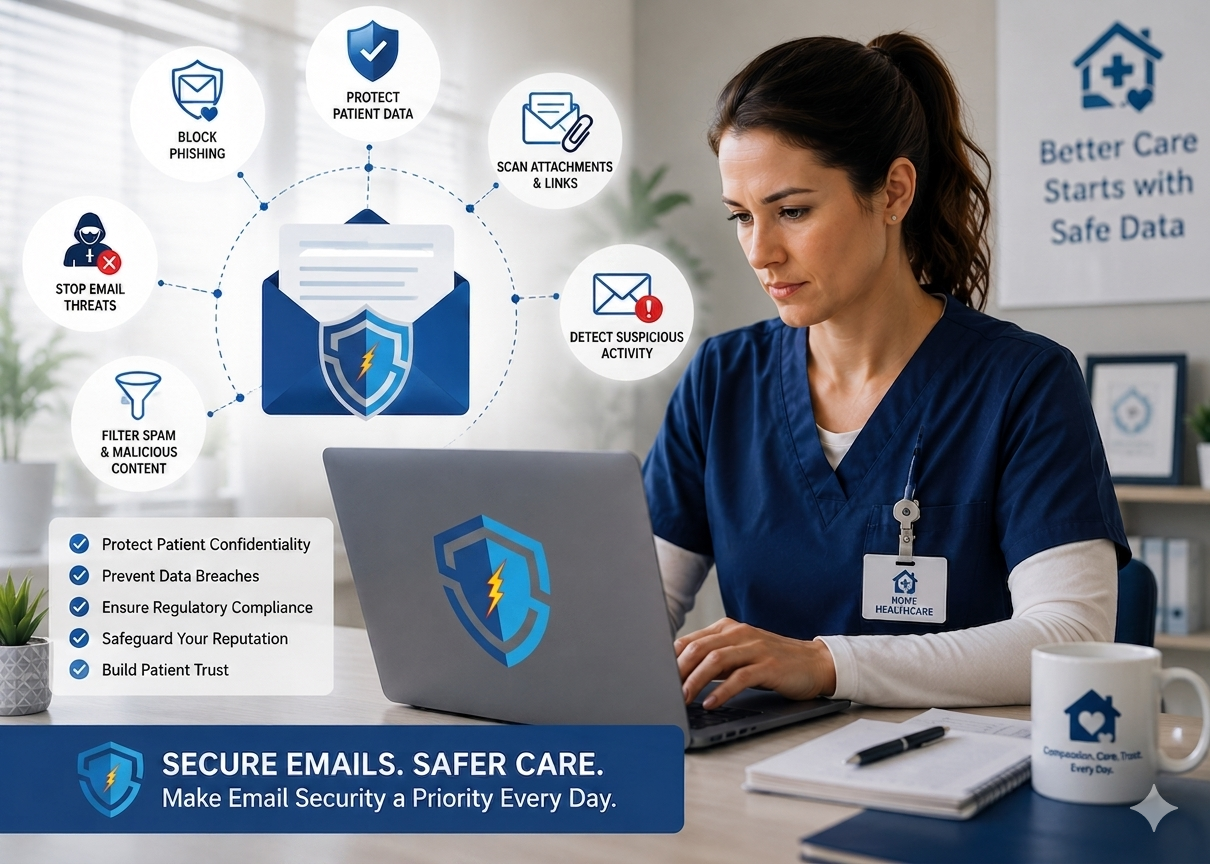
Home healthcare agencies depend on communication.
Care coordination, physician orders, referrals, scheduling updates, payroll notifications, patient documentation, billing conversations, vendor support, caregiver communication, and compliance workflows all move through email every day.
That makes email one of the most important operational systems inside a home healthcare agency.
It also makes email one of the most dangerous.
For many agencies, cybersecurity discussions focus heavily on ransomware, endpoint protection, HIPAA compliance, or backups. Those areas matter. But in practice, many of the most damaging healthcare cyber incidents still begin with a simple email.
A phishing link.
A fake invoice.
A compromised Microsoft 365 account.
An employee tricked into resetting credentials.
An attacker impersonating a trusted vendor.
An urgent request that bypasses normal procedures.
The reality is straightforward: if attackers can gain access to an agency’s email environment, they can often gain access to everything else.
That is why email security should no longer be treated as a basic IT setting or a secondary cybersecurity concern.
For home healthcare agencies, email security has become a patient trust issue, a compliance issue, a business continuity issue, and a leadership issue at the same time.
Email Remains One of the Most Common Entry Points for Cyberattacks
Healthcare organizations continue to face significant cyber pressure, and email remains one of the primary attack vectors.
The FBI’s Internet Crime Complaint Center reported that phishing and spoofing remained among the most reported cybercrimes in the United States in 2024, with more than 193,000 complaints filed. Business Email Compromise, commonly called BEC, generated nearly $2.8 billion in reported losses in 2024 alone. Across 2022 through 2024, reported BEC-related losses approached $8.5 billion.
Those numbers are not limited to large enterprises or Fortune 500 organizations.
Small and mid-sized healthcare providers are increasingly targeted because attackers understand that many organizations operate with limited security resources, lean IT teams, high operational pressure, and distributed workforces.
Home healthcare agencies are especially exposed.
Staff work remotely.
Caregivers use mobile devices.
Supervisors access systems from the field.
Administrators communicate constantly with payers, physicians, pharmacies, referral sources, and vendors.
Email sits at the center of all of it.
That creates opportunity for attackers.
Why Home Healthcare Agencies Face Unique Email Security Risks
A hospital may have centralized IT governance, segmented networks, and full-time cybersecurity teams. Many home healthcare agencies operate differently.
A typical agency may have:
field clinicians using mobile devices,
office staff accessing cloud email platforms,
remote payroll workflows,
outsourced billing support,
multiple third-party vendors,
caregivers communicating after hours,
employees working from home,
agency-owned and personal devices mixed together.
This environment creates complexity.
Patient information may move through:
Microsoft 365,
Google Workspace,
PDF attachments,
intake forms,
spreadsheets,
referral emails,
scanned physician orders,
payroll messages,
scheduling notifications,
cloud file-sharing links,
mobile email applications.
That means a compromised email account is not just an email problem.
It can become:
an ePHI exposure problem,
a ransomware problem,
a payroll fraud problem,
a vendor impersonation problem,
a business continuity problem,
a HIPAA breach notification problem.
This is why email security deserves executive attention.
Attackers Understand Healthcare Operations
Modern phishing attacks are no longer obvious.
Many fraudulent emails now imitate:
Microsoft login pages,
payroll notifications,
DocuSign requests,
EMR alerts,
vendor invoices,
password reset prompts,
physician communications,
payer messages.
Some attackers monitor conversations quietly after compromising an inbox. They study communication patterns, signatures, invoices, workflows, and relationships before launching fraud attempts.
This is especially dangerous in healthcare environments where urgency is common.
Staff members are busy.
Messages arrive constantly.
Care coordination cannot stop simply because someone is suspicious of an email.
Attackers understand this pressure.
That is why phishing attacks increasingly rely on operational realism instead of obvious technical tricks.
In late 2025, cybersecurity researchers and industry analysts noted growing concern around AI-enhanced phishing campaigns, impersonation attacks, and increasingly sophisticated business email compromise techniques targeting organizations with limited security maturity.
The direction is clear.
Email attacks are becoming more convincing, not less.
Healthcare Email Security Gaps Remain Widespread
One of the more concerning trends in healthcare cybersecurity is how effectively phishing attacks continue to bypass organizations through email.
The 2025 KnowBe4 Phishing Threat Trends Report found that attackers are increasingly using AI-enhanced phishing techniques, impersonation campaigns, QR code phishing, credential theft pages, and business email compromise tactics designed to appear legitimate and exploit human trust. The report also noted that healthcare remains one of the most heavily targeted industries because of the value of patient data, operational urgency, and widespread dependence on cloud-based communication platforms.
For home healthcare agencies, these findings matter.
Many agencies rely heavily on Microsoft 365, Google Workspace, mobile email access, cloud collaboration tools, and distributed communication workflows to coordinate care, manage referrals, process billing, and support field staff.
That creates a larger attack surface.
Cloud email platforms are powerful, flexible, and operationally essential.
But they are not automatically secure.
Weak passwords, missing MFA, excessive permissions, unmanaged devices, legacy authentication, poor email authentication controls, and limited staff awareness can quickly create significant exposure.
Attackers understand that compromising a single email account can provide visibility into schedules, patient communication, financial workflows, vendor relationships, and internal operations.
That is why email security can no longer be treated as a secondary IT issue.
It has become part of operational resilience itself.
Multi-Factor Authentication Should Be Standard
If there is one email security control every home healthcare agency should prioritize immediately, it is multi-factor authentication.
Passwords alone are no longer sufficient.
Employees reuse passwords.
Credentials are stolen in third-party breaches.
Phishing emails trick users into entering login information into fake portals.
Attackers purchase credentials on criminal marketplaces.
A single compromised password can expose an entire email environment.
Multi-factor authentication adds another layer of verification that significantly reduces the likelihood that stolen credentials alone can be used successfully.
This matters enormously in healthcare.
The Change Healthcare cyberattack became one of the most disruptive healthcare cyber incidents in U.S. history. Public reporting and congressional testimony indicated that attackers gained access through compromised credentials tied to a system that reportedly lacked MFA protection.
For home healthcare agencies, MFA should be enabled for:
Microsoft 365,
Google Workspace,
administrator accounts,
payroll systems,
remote access tools,
cloud storage platforms,
EMRs,
billing systems,
vendor portals.
This should not be viewed as optional.
It should be viewed as operational protection.
Email Authentication Controls Matter More Than Many Agencies Realize
Many healthcare organizations focus on spam filtering while overlooking email authentication standards.
That is a mistake.
Technologies such as:
SPF,
DKIM,
DMARC,
MTA-STS,
help verify whether incoming and outgoing email messages are legitimate and properly authenticated.
Without these protections, attackers may spoof agency domains, impersonate leadership, or send fraudulent messages that appear legitimate.
A 2025 healthcare breach analysis found that many breached organizations lacked effective protections against spoofed email attacks and failed to properly verify sender legitimacy.
For a home healthcare agency, domain impersonation can damage:
patient trust,
referral relationships,
payer confidence,
internal operations,
financial workflows.
A spoofed email pretending to come from leadership can create chaos quickly.
Email Security Is Also a HIPAA Issue
Many healthcare leaders still think about HIPAA primarily in terms of policies and documentation.
But HIPAA also requires organizations to protect electronic protected health information through reasonable administrative, physical, and technical safeguards.
Email environments often contain:
patient records,
referral information,
care coordination details,
insurance data,
Social Security numbers,
billing information,
internal operational discussions.
That means a compromised inbox may trigger:
breach investigations,
regulatory scrutiny,
patient notifications,
contractual issues,
legal exposure.
OCR enforcement actions increasingly reflect the expectation that healthcare organizations implement reasonable cybersecurity safeguards aligned with modern threats.
This is why email security cannot be separated from compliance readiness.
They are connected.
Staff Training Must Become Continuous
Technology alone will not solve phishing risk.
People remain central to email security.
Employees need practical training that reflects real-world situations.
Staff should know how to identify:
fake login pages,
suspicious attachments,
urgent payment requests,
unusual password reset prompts,
impersonation attempts,
vendor invoice fraud,
suspicious links,
abnormal communication behavior.
Training should also address:
mobile device use,
public Wi-Fi,
texting risks,
personal email usage,
reporting expectations.
Importantly, agencies should create a culture where employees feel comfortable reporting suspicious activity quickly.
Fear-based cultures delay reporting.
Delayed reporting increases damage.
Research published in 2025 examining long-term phishing awareness found that continuous training programs significantly reduced successful compromise rates over time, while employee turnover created recurring security awareness gaps.
That finding is especially relevant for home healthcare agencies where workforce turnover may already be operationally challenging.
Security awareness is not a one-time training event.
It must become part of organizational culture.
Leadership Should Ask Hard Questions
Home healthcare leaders should be able to answer basic operational questions about email security.
For example:
Do all employees use MFA?
Are former employees removed immediately?
Can personal devices access company email?
Are email forwarding rules monitored?
Do we back up Microsoft 365 or Google Workspace separately?
Can attackers access our email from unmanaged devices?
Do we monitor suspicious login activity?
Do we have conditional access policies?
Are phishing simulations conducted regularly?
Do vendors have access to shared mailboxes?
Do employees know how to report suspicious messages?
How quickly can compromised accounts be disabled?
Do we know whether patient information exists inside email archives?
If leadership cannot answer these questions confidently, that is a visibility problem.
And visibility problems become security problems.
Is Your Home Healthcare Agency Prepared for Modern Email Threats?
ShieldForce helps home healthcare agencies strengthen email security, phishing resistance, HIPAA-aligned safeguards, endpoint protection, backup readiness, workforce awareness, and ransomware resilience across distributed care environments.
Our Home Healthcare Cyber Readiness Assessment helps agency leaders identify high-risk gaps across email systems, cloud platforms, mobile devices, user access, vendor exposure, and ePHI workflows before a cyber incident forces urgent action.
Schedule a complimentary assessment with ShieldForce today and gain practical visibility into the cybersecurity risks that could impact patient trust, operations, compliance, and long-term growth.