
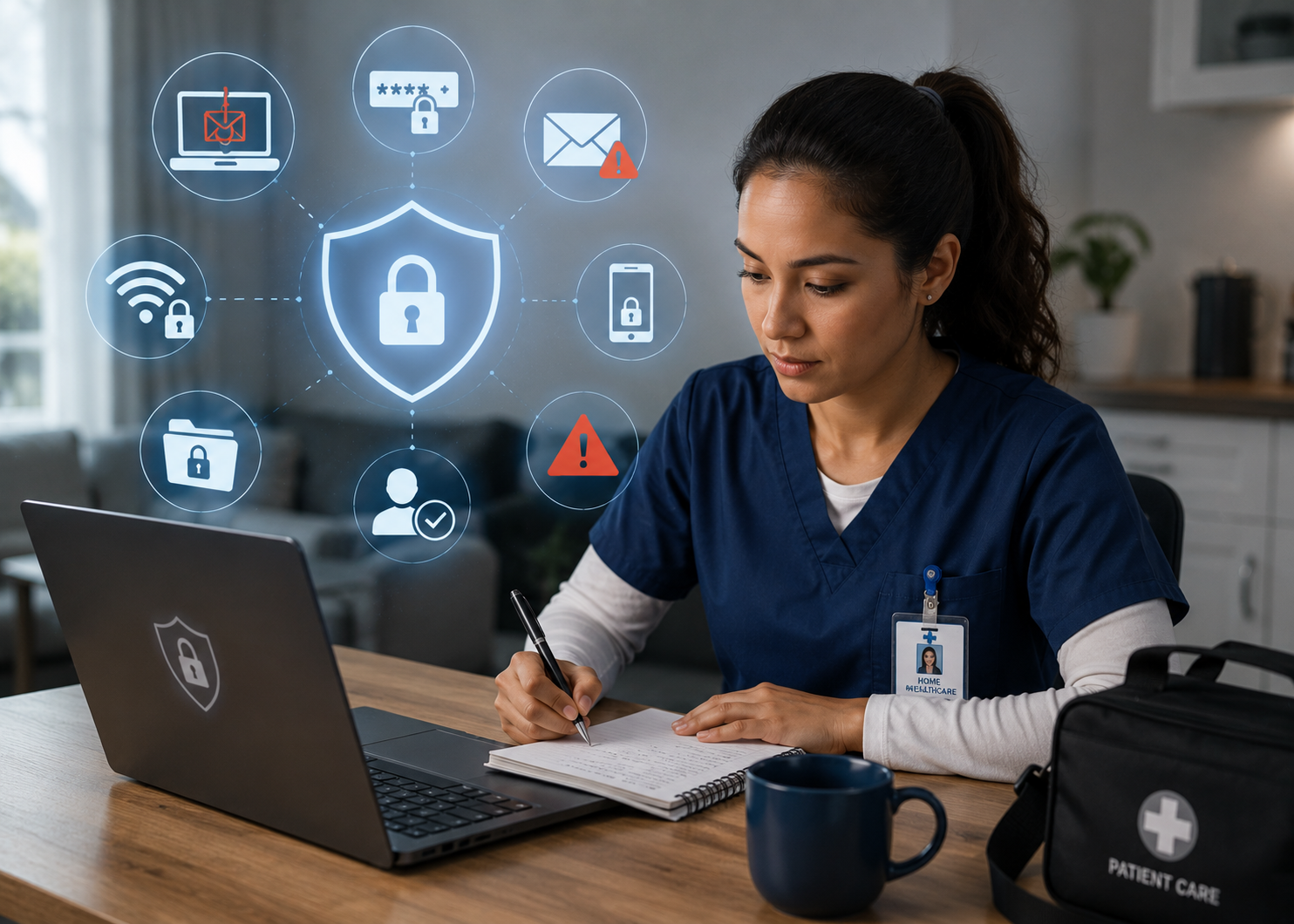
Trust is one of the greatest foundations in home healthcare.
Patients trust caregivers to enter their homes, protect their privacy, communicate professionally, and handle sensitive medical information responsibly. Agencies trust field staff to document visits accurately, use technology appropriately, and follow policies even when supervisors are not physically present.
But in modern home healthcare, trust alone is no longer enough.
Every mobile device, email account, cloud platform, scheduling application, EMR login, and caregiver communication channel creates potential cybersecurity exposure. And while healthcare organizations often focus heavily on technology controls, many cyber incidents still begin with a human decision.
A staff member clicks a phishing email. A weak password is reused across systems. Patient information is sent through an unsecured text message. A laptop is left in a vehicle. A caregiver responds to a fake payroll request. A former employee account remains active longer than it should.
These incidents are not always caused by malicious intent. In many cases, they are caused by confusion, rushed decision-making, poor awareness, or inadequate training.
That is why cybersecurity training has become one of the most important operational responsibilities for home healthcare agencies.
The challenge, however, is that much of the cybersecurity training employees receive does not work.
It may satisfy a compliance requirement. It may generate a certificate. But it often fails to change behavior in the field.
For home healthcare agencies, effective cybersecurity awareness must move beyond annual presentations and generic HIPAA videos. Training must reflect the realities of mobile healthcare work, distributed teams, patient-facing communication, and the operational pressures caregivers face every day.
Cybersecurity awareness is no longer just an HR or compliance activity.
It has become part of care delivery.
Why Home Healthcare Workers Face Unique Cybersecurity Risks
Home healthcare environments operate differently from traditional hospitals or centralized clinical settings.
Caregivers and administrative staff often work remotely, travel between patient homes, communicate through multiple systems, and access sensitive information from laptops, tablets, and mobile devices throughout the day. Some employees may use personal devices. Others may rely on home Wi-Fi networks, public internet connections, or shared family devices.
This creates a highly distributed technology environment.
At the same time, home healthcare employees are under pressure to respond quickly, coordinate schedules, communicate with families, complete documentation, manage visits, and address patient concerns in real time.
Cybercriminals understand this.
Attackers often target healthcare workers with phishing emails, fake invoices, credential theft attempts, payroll scams, impersonation attacks, and fraudulent password reset requests because busy employees are more likely to respond quickly without fully verifying legitimacy.
For many agencies, the greatest vulnerability is not necessarily the firewall or the antivirus software.
It is the everyday decisions employees make under pressure.
What Doesn’t Work in Cybersecurity Training
One of the biggest mistakes agencies make is treating cybersecurity awareness as a once-per-year compliance exercise.
Employees sit through a long presentation, watch generic videos, sign an attendance sheet, and return to work without retaining practical knowledge they can apply in real situations.
This approach creates several problems.
Generic Training Without Operational Relevance
Many cybersecurity programs are designed for broad corporate audiences rather than home healthcare environments.
A caregiver working in patient homes does not face the same operational realities as an office employee working inside a corporate headquarters. Training that ignores mobile workflows, patient communication challenges, and field operations often feels disconnected from daily responsibilities.
When employees cannot connect training to their actual work, engagement declines.
Overly Technical Language
Cybersecurity professionals sometimes explain risks using technical terminology employees do not fully understand.
Terms such as endpoint compromise, credential harvesting, lateral movement, or zero-day vulnerabilities may be meaningful to IT teams, but they are not always meaningful to caregivers, schedulers, intake coordinators, or administrative personnel.
Effective training must prioritize clarity over technical complexity.
Employees do not need to become cybersecurity engineers.
They need to recognize risky situations and know how to respond appropriately.
Fear-Based Messaging
Some organizations attempt to motivate employees through fear alone.
They emphasize catastrophic ransomware attacks, regulatory penalties, lawsuits, and termination policies without providing practical guidance employees can realistically follow.
Fear without support often creates silence rather than accountability.
Employees who fear punishment may delay reporting mistakes because they worry about blame or disciplinary consequences. That delay can make incidents significantly worse.
A strong security culture encourages rapid reporting, early escalation, and continuous learning.
Training That Happens Only Once Per Year
Cybersecurity threats evolve constantly.
Attack methods change. Phishing techniques improve. Employees forget information over time. New staff members join the organization. Existing staff members become complacent.
Annual training by itself is rarely sufficient.
Awareness must become continuous.
Policies Without Reinforcement
Some agencies maintain cybersecurity policies employees rarely read or fully understand.
Policies alone do not change behavior.
Employees need reminders, examples, reinforcement, leadership communication, and operational guidance integrated into daily workflows.
Without reinforcement, even well-written policies become disconnected from real behavior.
What Actually Works in Home Healthcare Cybersecurity Training
Effective cybersecurity awareness programs are practical, continuous, operationally relevant, and leadership supported.
The goal is not simply to satisfy compliance requirements.
The goal is to reduce preventable risk.
Scenario-Based Training
Home healthcare employees respond better to realistic situations they may actually encounter.
Examples include:
suspicious emails requesting payroll changes,
fake Microsoft 365 login pages,
text messages requesting patient information,
lost mobile devices,
unauthorized family member requests,
insecure public Wi-Fi use,
phishing attempts disguised as referrals or physician communications.
Scenario-based learning improves retention because employees can visualize the situation within their own work environment.
Training becomes practical rather than theoretical.
Short, Continuous Awareness Reminders
Long annual presentations are often ineffective.
Short reminders delivered consistently throughout the year tend to produce stronger awareness outcomes.
Examples include:
monthly phishing reminders,
short awareness videos,
cybersecurity tip emails,
brief team meeting discussions,
simulated phishing exercises,
login screen reminders,
policy refreshers during onboarding.
Small, recurring awareness moments help reinforce secure behavior over time.
Leadership Participation
Employees pay attention to what leadership prioritizes.
If cybersecurity training appears isolated within IT or compliance departments, staff may assume it is not operationally important.
When agency owners, administrators, and department leaders actively discuss cybersecurity expectations, employees recognize that security is part of organizational culture rather than an optional technical concern.
Leadership visibility matters.
Clear Reporting Processes
Employees should know exactly what to do if something feels suspicious.
Who should they contact?
What happens after they report something?
Will they be blamed for reporting a mistake?
Clear escalation procedures improve response times and reduce confusion during potential incidents.
In many cases, rapid reporting prevents a small issue from becoming a major breach.
Simulated Phishing Exercises
One of the most effective training tools is controlled phishing simulation.
Employees receive realistic but harmless phishing emails designed to test awareness in a safe environment. Agencies can then identify common weaknesses and reinforce education where needed.
The goal is not humiliation.
The goal is operational improvement.
Organizations that use phishing simulations regularly often develop stronger employee awareness over time because staff become more cautious about unexpected requests, links, attachments, and login prompts.
Mobile Device Security Training
Because home healthcare workers rely heavily on mobile technology, agencies should provide practical guidance around:
device locking,
screen privacy,
secure Wi-Fi use,
lost device reporting,
approved communication channels,
password management,
multi-factor authentication,
secure document handling,
patient information storage.
These operational behaviors directly affect HIPAA exposure and organizational risk.
Security Culture Matters More Than Compliance Alone
Compliance training and operational security awareness are not always the same thing.
An agency may technically complete annual HIPAA education requirements while still maintaining weak cybersecurity culture.
Real security culture exists when employees:
pause before clicking suspicious links,
verify unusual requests,
report concerns quickly,
understand why safeguards matter,
recognize their role in protecting patient information,
and feel supported when escalating potential problems.
That culture cannot be created through one presentation alone.
It requires repetition, leadership engagement, operational consistency, and ongoing reinforcement.
Human Error Remains One of the Largest Cybersecurity Risks
The World Economic Forum has noted that human behavior continues to play a major role in cybersecurity incidents, with many breaches linked to employee actions, phishing, credential misuse, or social engineering tactics.
For home healthcare agencies, this reality matters because staff members regularly interact with sensitive patient data while working in decentralized environments outside traditional office settings.
Technology remains essential.
But technology alone cannot fully protect an organization if employees are unprepared to recognize and respond to cyber threats appropriately.
Cyber resilience depends on both systems and people.
What Home Healthcare Agencies Should Do Next
Agencies do not need perfect cybersecurity awareness programs immediately.
But they do need consistent progress.
Leadership should begin by evaluating current training effectiveness rather than simply confirming whether training exists.
Important questions include:
Do employees understand real phishing risks?
Can staff recognize suspicious login pages?
Do caregivers know how to report lost devices?
Are employees using approved communication methods?
Is cybersecurity discussed regularly?
Are simulated phishing exercises conducted?
Do new hires receive operational security training during onboarding?
Are managers reinforcing expectations consistently?
Cybersecurity awareness should be treated as an ongoing operational discipline rather than a once-per-year compliance event.
ShieldForce helps home healthcare agencies evaluate workforce cybersecurity readiness, strengthen employee awareness programs, improve phishing resilience, and identify operational security gaps across mobile workers, devices, cloud systems, email platforms, and ePHI workflows.
Schedule a complimentary cybersecurity readiness consultation with ShieldForce today and take the next step toward building a stronger, more resilient culture of security across your organization.