
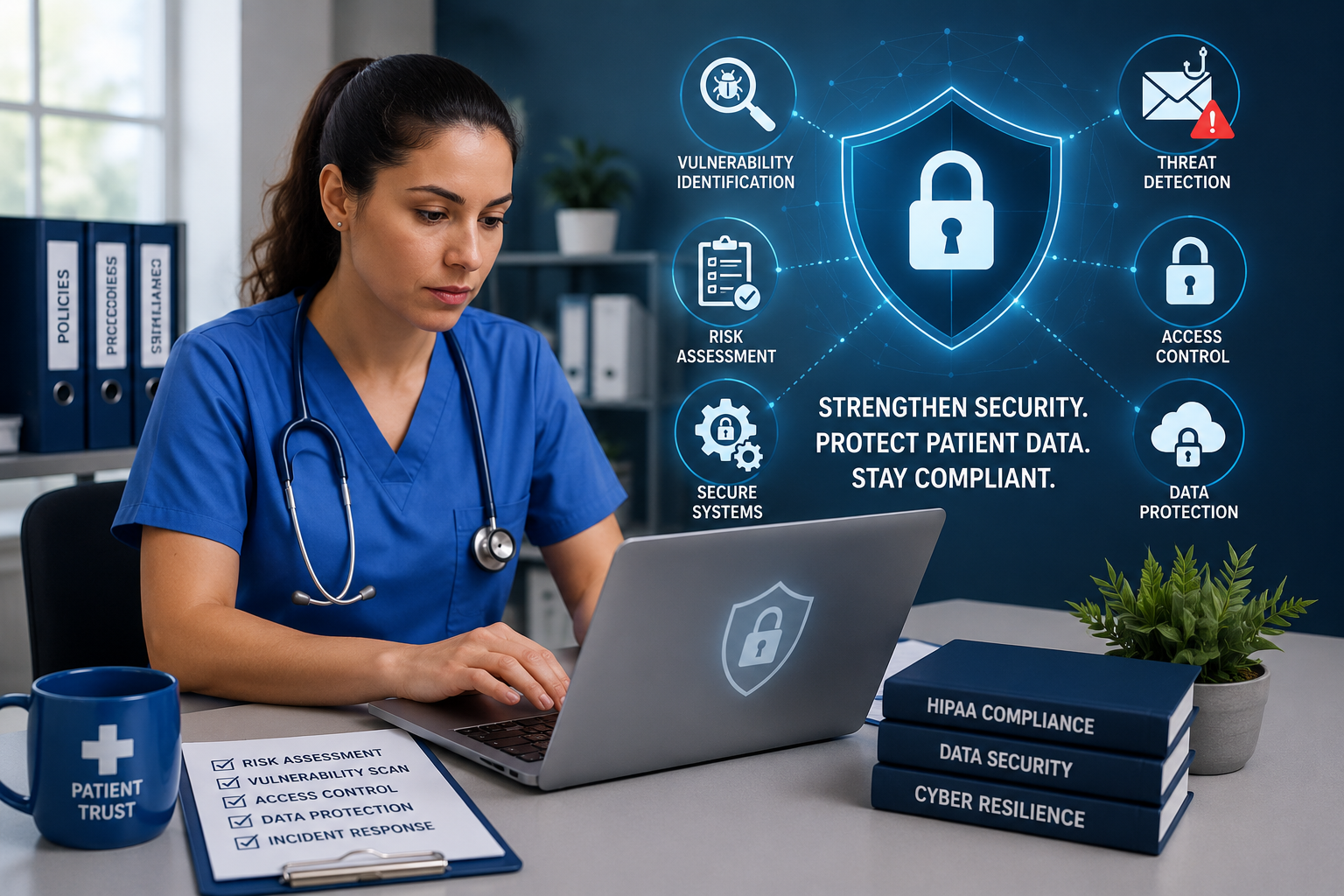
Healthcare agencies are becoming more digital, more connected, and more operationally dependent on technology than ever before.
Patient records move through cloud platforms. Staff communicate across email and mobile devices. Scheduling systems connect with billing platforms. Care teams access information remotely. Vendors support everything from payroll to electronic health records.
That convenience improves care delivery.
But it also expands cyber risk.
For many healthcare agencies, cybersecurity is no longer limited to hospitals or enterprise health systems. Home healthcare agencies, behavioral health providers, community clinics, hospice organizations, therapy practices, and long-term care providers now face the same reality:
Patient information is constantly moving across people, devices, applications, and third-party systems.
That changes the risk environment significantly.
A phishing email can compromise patient records. A ransomware incident can interrupt operations. A weak password can expose sensitive information. A poorly managed vendor relationship can create compliance exposure. A lost laptop can quickly become a reputational problem.
This is no longer just an IT issue.
It is an operational issue, a compliance issue, and a patient trust issue at the same time.
Why Healthcare Agencies Are Becoming More Vulnerable
Healthcare agencies operate in environments that are highly dependent on accessibility, speed, coordination, and communication.
Care teams need information quickly. Administrators need systems available at all times. Clinicians need remote access to patient records. Billing departments depend on connected platforms. Leadership depends on operational continuity.
That pressure creates complexity.
Many agencies now rely on:
cloud-based electronic health record systems
remote workforce environments
mobile devices
email communication platforms
scheduling applications
third-party vendors
telehealth technologies
shared file storage systems
remote access tools
Every connected system increases the potential attack surface.
For smaller and mid-sized healthcare organizations, this challenge can become even more difficult because resources are often limited. Many agencies operate without dedicated cybersecurity teams, formal security governance, or mature internal IT departments.
As a result, many healthcare agencies develop security gaps gradually over time without fully realizing the level of exposure that exists across their environment.
Common vulnerabilities often include weak password practices, lack of multi-factor authentication, outdated devices, unmanaged remote access, insufficient staff training, poor vendor oversight, missing backup protections, and incomplete visibility into where patient information is stored.
These issues are more common than many organizations realize.
In many cases, agencies believe they are secure because systems appear to function normally. Staff can access records. Billing processes continue. Communication platforms remain operational.
But operational functionality does not always mean operational security.
An organization may continue operating for months or years while critical vulnerabilities remain undetected in the background.
That is what makes healthcare cybersecurity risk so dangerous.
The warning signs are often invisible until an incident occurs.
Why Patient Data Has Become a Major Target
Healthcare information has become highly valuable to cybercriminals because medical and personal data can be exploited in multiple ways.
Unlike a stolen credit card, medical information cannot easily be replaced. Patient records often contain names, addresses, insurance information, dates of birth, medical histories, identification numbers, financial data, and other sensitive information that can be used for fraud, identity theft, or extortion.
Healthcare organizations also face another challenge:
Many agencies cannot tolerate operational downtime.
When patient care depends on system availability, attackers understand that healthcare organizations may feel pressure to restore operations quickly during a ransomware incident.
That creates leverage.
A ransomware event can disrupt scheduling, delay billing, interrupt communication, impact care coordination, and create uncertainty across the organization. In severe situations, agencies may struggle to access patient records, care plans, or operational systems needed to maintain continuity of care.
This is why cybersecurity in healthcare must be viewed as part of operational resilience.
Protecting systems is not only about preventing technical disruption.
It is about protecting the organization’s ability to continue delivering care safely and consistently.
The Compliance Risks Continue to Grow
Healthcare agencies must also navigate increasing regulatory expectations around data protection and privacy.
Regulations such as HIPAA already require covered entities and business associates to implement safeguards that protect the confidentiality, integrity, and availability of electronic protected health information.
That responsibility extends across administrative, technical, and physical safeguards.
For many agencies, however, compliance challenges emerge when growth outpaces governance.
New systems are added quickly. Vendors are onboarded. Remote access expands. Staff responsibilities change. Devices multiply. Communication tools evolve.
But security processes often fail to mature at the same pace.
That creates gaps between operational reality and compliance expectations.
An agency may have policies on paper while lacking practical enforcement across daily operations. Access reviews may not occur regularly. Former employees may retain access longer than expected. Vendor security practices may not be evaluated thoroughly. Backup restoration may never be tested.
Over time, those weaknesses accumulate.
This is one reason healthcare agencies are seeing greater scrutiny from regulators, cyber insurers, referral partners, and compliance assessors.
Organizations are increasingly expected to demonstrate not only that policies exist, but that security practices are actively implemented, reviewed, and maintained.
What Stronger Security Actually Looks Like
For healthcare agencies, cybersecurity improvement does not begin with fear.
It begins with visibility.
An organization must first understand where patient information exists, who can access it, how systems connect, which vendors are involved, and where operational dependencies create risk.
Without that visibility, security decisions become reactive instead of strategic.
A stronger security posture typically starts with foundational controls such as:
multi-factor authentication
secure password management
full disk encryption
endpoint protection
staff cybersecurity awareness training
role-based access controls
secure remote access
backup and disaster recovery planning
vendor risk management
ongoing risk assessments
incident response planning
These controls are not only technical safeguards.
They are operational safeguards.
They reduce the likelihood that a single mistake, compromised account, or system failure becomes a larger organizational crisis.
Most importantly, stronger cybersecurity creates resilience.
It allows healthcare agencies to continue operating effectively even when threats, disruptions, or unexpected incidents occur.
But strengthening security requires more than implementing safeguards alone. Healthcare agencies must also understand where vulnerabilities already exist across their systems, devices, workflows, vendors, and operational environment.
Why Vulnerability Assessments Have Become Essential
For healthcare agencies, identifying vulnerabilities cannot be treated as a one-time exercise.
Technology environments change constantly. New employees are hired. Vendors are added. Devices are replaced. Software updates are installed. Remote access expands. Cloud applications evolve. Operational workflows shift over time.
Every change can introduce new risk.
That is why vulnerability assessments have become an essential part of healthcare cybersecurity and compliance readiness.
A vulnerability assessment helps an organization identify weaknesses before attackers, system failures, or compliance issues expose them under pressure.
For healthcare agencies, this process should extend beyond technical scanning alone.
A meaningful assessment evaluates how patient information moves throughout the organization, how systems interact, where operational dependencies exist, and which weaknesses could create business disruption or compliance exposure.
This includes reviewing:
devices connected to the network
outdated operating systems or unsupported software
weak password practices
missing multi-factor authentication
exposed remote access tools
email security gaps
inactive user accounts
vendor access permissions
unsecured mobile devices
backup protection
cloud application security settings
staff access privileges
data storage locations
incident response readiness
The goal is not simply to generate a technical report.
The goal is to understand where the organization is operationally vulnerable.
That distinction matters.
A healthcare agency may technically function well on the surface while still carrying significant hidden risk beneath daily operations.
For example, an agency may discover that former employees still retain system access, backups have never been tested, sensitive files are stored in unsecured locations, or remote devices lack proper protection.
These issues are often discovered only after a structured assessment takes place.
This is one reason vulnerability assessments should be performed regularly rather than only after an incident occurs.
Cyber threats evolve continuously. Operational environments change quickly. Security controls that worked one year ago may no longer provide sufficient protection today.
Healthcare agencies that conduct recurring assessments are often in a stronger position to:
identify weaknesses earlier
prioritize remediation efforts
improve HIPAA compliance readiness
strengthen operational resilience
support cyber insurance requirements
reduce ransomware exposure
improve vendor oversight
enhance leadership visibility into risk
Most importantly, vulnerability assessments help healthcare agencies move from reactive security toward proactive risk management.
Instead of waiting for disruption, organizations gain the ability to identify gaps early, strengthen safeguards intentionally, and improve long-term operational stability.
That is becoming increasingly important in modern healthcare environments where patient trust, regulatory expectations, and operational continuity all depend on secure and reliable systems.
Security Is Becoming Part of Organizational Leadership
One of the biggest shifts happening across healthcare is that cybersecurity is no longer isolated within IT departments alone.
Leadership teams are increasingly expected to understand operational cyber risk because cybersecurity now affects compliance, patient trust, financial stability, business continuity, insurance exposure, vendor relationships, and organizational reputation.
That changes the conversation significantly.
Healthcare leaders do not necessarily need to become technical experts.
But they do need visibility into risk.
They need to understand:
where the organization is vulnerable
which systems are most critical
how patient information is protected
how quickly operations could recover from disruption
which vendors introduce third-party risk
whether staff are prepared to recognize threats
whether security controls are actually functioning as intended
These are leadership questions now.
And the agencies that treat cybersecurity as part of operational governance will often be in a stronger position moving forward.
The agencies that delay these conversations may eventually find themselves responding under pressure after a breach, ransomware incident, compliance review, or operational disruption forces action.
The Future of Healthcare Requires Stronger Cyber Resilience
Healthcare will continue becoming more digital, more connected, and more decentralized.
Remote care will expand. Cloud platforms will continue evolving. Mobile workforces will remain common. Data sharing requirements will increase. Third-party integrations will grow.
That direction is clear.
As healthcare operations become more dependent on technology, cybersecurity will become increasingly tied to organizational stability and patient trust.
The healthcare agencies that recognize this early will be better positioned to strengthen operations, maintain compliance, protect sensitive information, and adapt to future regulatory expectations.
The goal is not perfection.
The goal is preparedness, resilience, and operational maturity.
Because in modern healthcare, protecting patient information is no longer separate from protecting the organization itself.
Is Your Agency Prepared to Address Security Vulnerabilities?
ShieldForce helps healthcare agencies identify security gaps across systems, devices, email, cloud platforms, vendors, remote access environments, and patient data workflows to strengthen HIPAA-aligned safeguards, reduce ransomware exposure, improve compliance readiness, and build stronger operational cyber resilience before a breach, audit, or operational disruption forces the conversation.
Schedule a complimentary Vulnerability Assessment with ShieldForce today and gain a clearer understanding of where your agency stands, where vulnerabilities exist, and what practical steps can strengthen resilience across your environment.